 LinkedIn
  You-tube


Choosing the right ERP software is one of the most important business decisions a growing organization will make. An Enterprise Resource Planning (ERP) platform becomes the operational backbone of the business, connecting finance, purchasing, inventory, manufacturing, sales, customer service, and reporting into a single system. The right ERP can improve productivity, increase visibility, and support long-term growth. The wrong ERP can create inefficiencies, increase operational costs, and limit scalability.
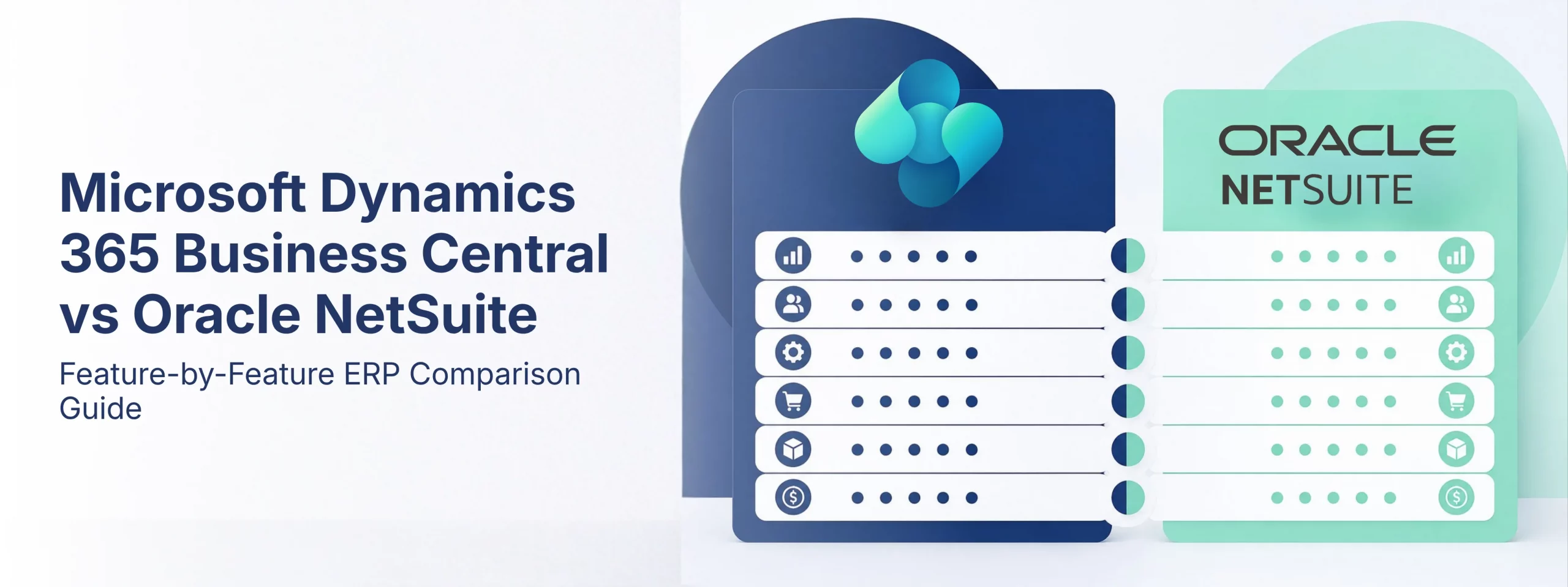
For many organizations evaluating cloud ERP software, the decision often comes down to two leading solutions: Microsoft Dynamics 365 Business Central and Oracle NetSuite ERP.
Both platforms are widely recognized in the ERP market and offer comprehensive capabilities for financial management, inventory control, business operations, and reporting. However, they differ significantly in their approach to manufacturing, warehouse management, Microsoft ecosystem integration, artificial intelligence, licensing models, and overall user experience.
Dynamics 365 Business Central evolved from a manufacturing and distribution heritage, making it particularly strong in operational management and supply chain processes. NetSuite, by contrast, originated as a cloud financial management platform and remains particularly popular among SaaS companies and organizations with complex revenue recognition requirements.
This guide provides a practical, feature focused comparison of Business Central and NetSuite to help business leaders, CFOs, operations managers, and IT decision-makers determine which ERP platform aligns best with their requirements.
In Part 1 of this ERP Buyer’s Guide Series, we focus on platform capabilities and functionality. We compare Business Central and NetSuite across:
- Platform foundations and architecture
- Financial management capabilities
- Supply chain and inventory management
- CRM and customer management
- Manufacturing functionality
- Artificial intelligence and automation
- Industry suitability
In Part 2, we will examine pricing, licensing, implementation timelines, total cost of ownership (TCO), scalability, and final recommendations.
Business Central vs NetSuite: Executive Summary
For most small and mid-sized businesses, Dynamics 365 Business Central provides a stronger combination of operational functionality, Microsoft ecosystem integration, manufacturing capabilities, and long-term value. Organizations operating in manufacturing, distribution, wholesale, retail, construction, and professional services often benefit from Business Central’s native inventory management, warehouse operations, production planning, and reporting capabilities.
Oracle NetSuite remains a strong ERP platform, particularly for SaaS and technology companies that require advanced subscription billing and revenue recognition functionality. It has a well-established reputation in subscription-based business models and continues to be a popular choice among venture backed technology organizations.
If your business relies heavily on Microsoft 365, manages physical inventory, operates multiple entities, or requires advanced operational management, Business Central will typically provide broader functionality and a more seamless user experience.
Business Central vs NetSuite at Glance
Before diving into the details, here’s a high-level comparison of the two ERP platforms.
| Category | Microsoft Dynamics 365 Business Central | Oracle NetSuite |
|---|---|---|
| Best Fit | Manufacturing, Distribution, Retail, Services | SaaS, Technology, Subscription Businesses |
| Cloud Deployment | Yes | Yes |
| Microsoft 365 Integration | Native | Third-Party |
| Manufacturing | Included in Premium | Additional Module |
| Warehouse Management | Included | SuiteWMS Add-On |
| AI Capabilities | Microsoft Copilot | Oracle AI |
| Multi-Company Management | Included | OneWorld Add-On |
| Reporting | Power BI Integration | SuiteAnalytics |
| Pricing Transparency | Published | Quote-Based |
While both platforms are capable ERP solutions, Business Central tends to appeal to organizations looking for a comprehensive business management platform that integrates tightly with Microsoft technologies. NetSuite often appeals to SaaS companies and organizations with advanced subscription billing or revenue recognition requirements.
What Is the Difference Between Business Central and NetSuite?
Dynamics 365 Business Central and Oracle NetSuite are both cloud-based ERP systems designed to help organizations manage financials, operations, inventory, purchasing, and customer relationships. However, their origins and strengths are very different.
Business Central was built around operational management. Its roots in manufacturing, distribution, and inventory control are evident throughout the platform. Capabilities such as warehouse management, production planning, inventory tracking, and supply chain management are deeply embedded into the system and work seamlessly alongside finance and reporting.
NetSuite started as a financial management platform and expanded into operational areas over time. As a result, it remains particularly strong in accounting, subscription billing, revenue recognition, and SaaS business models. Many advanced operational capabilities are available through additional modules rather than being included within the base platform.
For businesses managing inventory, warehousing, production, or multiple operational processes, Business Central often feels more naturally aligned with day-to-day business activities. For businesses primarily focused on subscription revenue and complex financial reporting, NetSuite can offer advantages in specific use cases.
Platform Overview: Understanding the Foundations
Every ERP platform carries its history in its architecture. Understanding where Business Central and NetSuite originated helps explain why they behave so differently today.
The industries they were originally designed to serve continue to influence their strengths, workflows, and user experience decades later.
Microsoft Dynamics 365 Business Central
It traces its roots back to Navision, a business management platform originally developed in Denmark in 1984. From the beginning, Navision focused on helping manufacturers, distributors, wholesalers, and retailers manage operations, inventory, finance, and supply chains within a unified platform.
Microsoft acquired Navision in 2002 and spent years modernizing the solution for the cloud era. In 2018, the platform evolved into Dynamics 365 Business Central and became Microsoft’s flagship ERP solution for small and mid-sized businesses.
Today, Business Central serves organizations across more than 170 countries and sits at the center of Microsoft’s business applications ecosystem. It benefits from integration with:
- Microsoft 365
- Microsoft Teams
- Outlook
- Excel
- Power BI
- Power Platform
- Azure
- Microsoft Copilot
Because of its operational heritage, Business Central excels in areas such as manufacturing, inventory management, warehouse operations, purchasing, and supply chain visibility.
Key Strengths of Business Central
- Financial Management
- Manufacturing
- Supply Chain Management
- Inventory Control
- Warehouse Management
- Project Management
- Power BI Reporting
- Microsoft 365 Integration
- AI-Powered Productivity
Oracle NetSuite ERP
Oracle NetSuite was founded in 1998 under the name NetLedger and became one of the world’s first cloud-native ERP platforms. Unlike many traditional ERP systems that later transitioned to the cloud, NetSuite was designed as a web-based application from the beginning.
The platform gained significant traction among technology companies, SaaS organizations, and professional services firms seeking strong financial management and cloud accessibility.
Today, NetSuite is widely recognized for:
- Financial Management
- Revenue Recognition
- Subscription Billing
- Global Accounting
- Multi-Currency Operations
- Professional Services Automation
Its strongest adoption remains within SaaS, technology, and subscription-driven organizations.
Key Strengths of NetSuite
- Financial Management
- Subscription Revenue Management
- Revenue Recognition
- Global Business Operations
- Professional Services
- SaaS Business Models
Why Platform Origins Matter
The origins of each ERP platform influence how functionality is delivered today.
Business Central evolved from an operational management platform and expanded into financial management. As a result, manufacturing, inventory management, warehouse operations, and purchasing workflows feel deeply integrated into the platform.
NetSuite evolved from a financial management platform and expanded into operational areas over time. Consequently, financial reporting, subscription billing, and revenue recognition remain among its strongest capabilities.
This distinction becomes particularly important when evaluating ERP software for growing businesses. Organizations that manufacture products, manage inventory, operate warehouses, or rely on supply chain efficiency often find Business Central more aligned with their operational needs. Organizations with complex subscription revenue models may find NetSuite better suited to their financial requirements.
Why Your ERP Choice Is One of the Most Consequential Decisions You Will Make
Selecting an ERP platform is not the same as selecting a new accounting package, CRM system, or collaboration tool. An ERP becomes the central operating system of the business, connecting virtually every department and process.
When implemented successfully, an ERP creates a single source of truth across the organization. Finance, operations, sales, purchasing, inventory, and leadership teams all work from the same data, improving visibility and reducing errors.
When implemented poorly or when the wrong platform is selected the consequences can be significant.
A poor ERP choice often leads to:
- Manual workarounds and spreadsheet dependency
- Delayed reporting and reduced visibility
- Inventory inaccuracies
- Operational inefficiencies
- Poor user adoption
- Increased support and maintenance costs
By contrast, the right ERP platform enables organizations to:
- Improve operational efficiency
- Gain real-time business visibility
- Strengthen financial controls
- Improve customer service
- Support growth and scalability
- Reduce reliance on disconnected systems
Most organizations expect their ERP investment to support them for five to ten years. That makes ERP selection one of the most strategically important technology decisions a business will make.
Detailed Feature Comparison Across Every Major Function
What follows evaluates both platforms not just on whether a capability exists both can claim coverage across all major ERP categories but on four tests: how deeply the feature is built into the platform’s core; how much it costs to unlock; how usable it is without specialist training; and how well it connects to adjacent capabilities. Business Central wins 16 of 21 functional categories evaluated.
Financial Management
Business Central’s financial management module is the product of four decades of refinement. Multi-currency, multi-entity consolidation, and multi-language reporting are built into the base licence not separate modules. Its live Excel integration allows finance teams to work in the environment they already know, with data updating in real time. AI-powered bank reconciliation turns a process that used to take days into one that takes hours.
NetSuite’s financials are strong for single-entity businesses. The challenge appears the moment you grow: adding a second legal entity immediately triggers the OneWorld add-on cost, which can add thousands of dollars per year. Excel integration is limited to data export rather than live sync meaning changes in spreadsheets must be manually re-imported.
| Feature / Capability | Business Central | Oracle NetSuite |
|---|---|---|
| General Ledger & Multi-entity | Multi-company, multi-currency, unlimited dimensions all in the base Essentials licence at $70/user/month. No add-on required. | Solid GL for single-entity. Multi-entity consolidation requires the OneWorld add-on at meaningful additional annual cost. |
| Bank Reconciliation | AI-driven automatic matching connected to 1,000+ banks globally. System learns from previous reconciliations and improves accuracy over time. | Available and functional. Direct bank feed connectivity requires SuiteApps for many banks; less sophisticated automatic matching. |
| Budgeting & Forecasting | Native budget management with live bi-directional Excel integration and Power BI visualisation. No additional module needed. | Planning & Budgeting module available at additional cost. Excel connection is export-only — updated figures must be manually re-imported. |
| Tax Compliance (VAT/GST) | Localised tax engines for 40+ countries embedded natively. Microsoft Tax Service updates rates automatically. | Available but complex non-US tax regimes often require third-party SuiteApps. Weaker for businesses outside North America. |
| Financial Reporting | Power BI embedded natively — 100+ pre-built dashboards, no separate BI licence required. Live Excel query function included. | SuiteAnalytics is capable but steeper learning curve. Most organisations need a dedicated analyst or consultant to build useful reports. |
Supply Chain & Inventory Management
Business Central handles the full complexity of modern inventory management natively bin-level location tracking, FIFO/FEFO picking strategies, lot numbers, serial numbers, expiry date management, and multi-warehouse transfers with full audit trails. None of this requires an add-on module. It is all included in the base Essentials licence at $70/user/month.
NetSuite’s inventory management is adequate for simpler requirements. The moment requirements become more sophisticated, costs climb: Advanced Inventory is a separate module, Warehouse Management is a separate module, and demand planning is a separate module. Each adds to annual licence cost and requires its own configuration project.
| Feature / Capability | Business Central | Oracle NetSuite |
|---|---|---|
| Inventory Tracking (bins, lots, serials, FEFO) | Complete multi-location inventory with bin-level tracking, lot/batch numbers, serial traceability, and FEFO picking all in Essentials licence. | Standard tracking included. Advanced capabilities (bin management, lot tracking, serial traceability) require the Advanced Inventory add-on module. |
| AI Demand Forecasting | Machine learning-based demand forecasting built into Premium tier. Analyses historical data, adjusts for seasonality and trend, recommends reorder quantities. | Demand planning module must be purchased separately. AI sophistication lags Business Central’s native ML engine. |
| Warehouse Management System | Full enterprise-grade WMS built in — directed put-away, pick wave management, bin replenishment, cross-docking, mobile device interfaces. No extra licence. | Basic warehouse operations included. Full WMS capability requires the SuiteWMS add-on at additional annual cost. |
Manufacturing – Where Business Central’s Heritage Shines
Business Central’s manufacturing module has been refined over 40 years in production environments. Production costs flow directly to the GL in real time, material consumption updates inventory instantly, and finished goods appear in stock the moment a production order is completed without any manual entry.
| Feature / Capability | Business Central | Oracle NetSuite |
|---|---|---|
| Bill of Materials | Multi-level BOM with version control and engineering change management built into Premium licence. Eliminates risk of production building from outdated specs. | Available with Manufacturing add-on module. Version control more limited than Business Central, increasing operational risk. |
| MRP & Production Scheduling | Native MRP and Master Production Scheduling in Premium. Calculates what to buy or make, in what quantities, by what dates. Prevents production stoppages from missing materials. | Basic planning available with add-on. Advanced MRP with capacity scheduling typically requires a third-party APS tool — adding cost and integration complexity. |
| Capacity Planning | Both finite and infinite capacity scheduling supported. Prevents chronic over-scheduling that causes missed delivery dates. | Capacity planning is limited in the NetSuite module. Most manufacturers need a third-party capacity planning tool. |
Technology, UX & Artificial Intelligence
Microsoft has made AI the defining investment of this decade. Its $13 billion annual AI research budget and exclusive OpenAI partnership fund capabilities that run natively within Business Central not as future promises, but as live features today. Copilot is woven throughout: generating product descriptions, predicting late invoice payments, suggesting bank reconciliation matches, and answering natural language questions about business data.
| Feature / Capability | Business Central | Oracle NetSuite |
|---|---|---|
| Microsoft Copilot AI | Embedded throughout Business Central — writes product descriptions, predicts late payments, recommends reorder quantities, answers plain-English questions about data. | Oracle is investing in AI but the depth and native integration significantly trails what Business Central delivers today. No equivalent to Copilot’s natural language interface. |
| User Interface & Ease of Use | Uses Microsoft 365 Fluent design language. Users familiar with Word, Excel, and Outlook reach productive competency within their first day or two. | Functional and improved, but consistently reported as having a steeper learning curve. New users typically need more structured, extended training. |
| No-Code Automation (Power Platform) | Power Automate has 900+ pre-built connectors to Business Central data. Business users build sophisticated automations without writing code. | SuiteScript (JavaScript-based) and SuiteFlow require developer skills. No equivalent to Power Platform’s no-code capability — almost all automation involves IT cost. |
Which ERP Is Better – Business Central or NetSuite?
After evaluating platform architecture, financial management, inventory control, supply chain operations, manufacturing capabilities, CRM functionality, artificial intelligence, and industry suitability, a clear pattern emerges: both Business Central and Oracle NetSuite are capable cloud ERP platforms, but they are designed to excel in different business environments.
For organizations operating in manufacturing, distribution, wholesale, retail, construction, and professional services, MS Dynamics 365 Business Central consistently delivers broader operational functionality, deeper Microsoft ecosystem integration, and a more unified user experience. Its strengths in inventory management, warehouse operations, production planning, reporting, and AI-powered productivity make it particularly attractive for growing businesses that need a scalable ERP platform without unnecessary complexity.
NetSuite remains a strong contender, especially for SaaS companies and organizations with sophisticated subscription billing and revenue recognition requirements. Its financial management capabilities and long-standing presence in the technology sector continue to make it a viable option for specific business models.
For the majority of small and mid-sized businesses evaluating ERP software in 2025, Business Central offers the strongest combination of operational capabilities, business intelligence, Microsoft integration, and future-ready AI innovation.

Continue to Part 2: Business Central vs NetSuite Pricing, TCO & Implementation Guide to determine which ERP platform delivers the best long-term value for your business.
Let’s discuss your ERP goals and build a roadmap for a successful digital transformation.
Need Help Choosing the Right ERP?