
 LinkedIn
  You-tube



Are Your Books Ready for Tax Season?
Tax season has a way of sneaking up on all of us. One day you’re focused on running your business, serving clients, and keeping things moving. Then suddenly it’s February, the deadline is staring you down, and you open your accounting software to find… a mess.
Receipts that were never entered. Bank transactions that don’t match. Categories that make no sense. That one month when you just stopped tracking things altogether because life got too busy.
Sound familiar? You’re in good company. Most small business owners, even smart, hardworking ones, have been right where you are. It’s not a reflection of how capable you are. It’s a reflection of how easy it is for bookkeeping to slip when you’re wearing ten hats at once.
That’s exactly why bookkeeping clean-up services exist and why more business owners than ever are turning to professionals to sort things out before it becomes a bigger problem.
By the end of this guide, you’ll know exactly what a bookkeeping clean-up involves, how the process works step by step, and how to find the right partner to get your finances back on solid ground so next tax season, you walk in prepared instead of panicked.
What Are Bookkeeping Clean-Up Services?
It refer to the professional process of reviewing, correcting, and organizing a business’s financial records that have fallen behind, become inaccurate, or were never properly set up in the first place.
These services typically cover:
- Reconciling bank and credit card statements – to match actual transactions
- Categorizing and coding transactions – that were missed or mislabeled
- Identifying and correcting data entry errors – across ledgers and accounts
- Resolving duplicate or missing transactions
- Cleaning up the Chart of Accounts – for clarity and tax compliance
- Preparing accurate financial statements – profit & loss, balance sheet, and cash flow
- Getting books audit-ready or CPA-ready ahead of filing season
Whether your books are six months behind or have never been properly maintained, a professional clean-up service can bring them up to date and set your business on a healthier financial path.
Why Do Books Get Messy in the First Place?
Understanding the root causes helps prevent the same problems from recurring. Here are the most common reasons businesses end up with disorganized finances:
- Rapid business growth – More transactions mean more chances for errors when there’s no system in place.
- DIY bookkeeping without expertise – Well-intentioned but undertrained staff (or owners) often make costly categorization mistakes.
- Software mismanagement – Using QuickBooks, Xero, or FreshBooks without proper setup leads to compounding errors over time.
- Inconsistent record-keeping – Skipping monthly reconciliations turns small errors into major discrepancies by year-end.
- Employee turnover – When bookkeepers leave mid-year, records can fall into disarray without a proper handoff.
- Mixing personal and business expenses – One of the most common pitfalls for small business owners and sole proprietors.
Warning Signs Your Books Need a Professional Clean-Up
Not sure if your books qualify as “messy”? Watch for these red flags:
- Your bank balance and accounting software balance never match
- You have uncleared transactions sitting for months
- You can’t produce a reliable profit & loss statement on demand
- Your accounts receivable or payable reports look unreliable
- Vendors or clients are disputing invoices or payments
- Your CPA regularly finds errors during tax preparation
- You’ve received IRS notices or state tax penalties
- You don’t know if your business is profitable
If even two or three of these apply to you, it’s time to consider a bookkeeping clean-up.
The Step-by-Step Bookkeeping Clean-Up Process
A professional bookkeeping clean-up isn’t just “fixing numbers”; it’s a systematic, multi-stage review. Here’s how the process typically works:
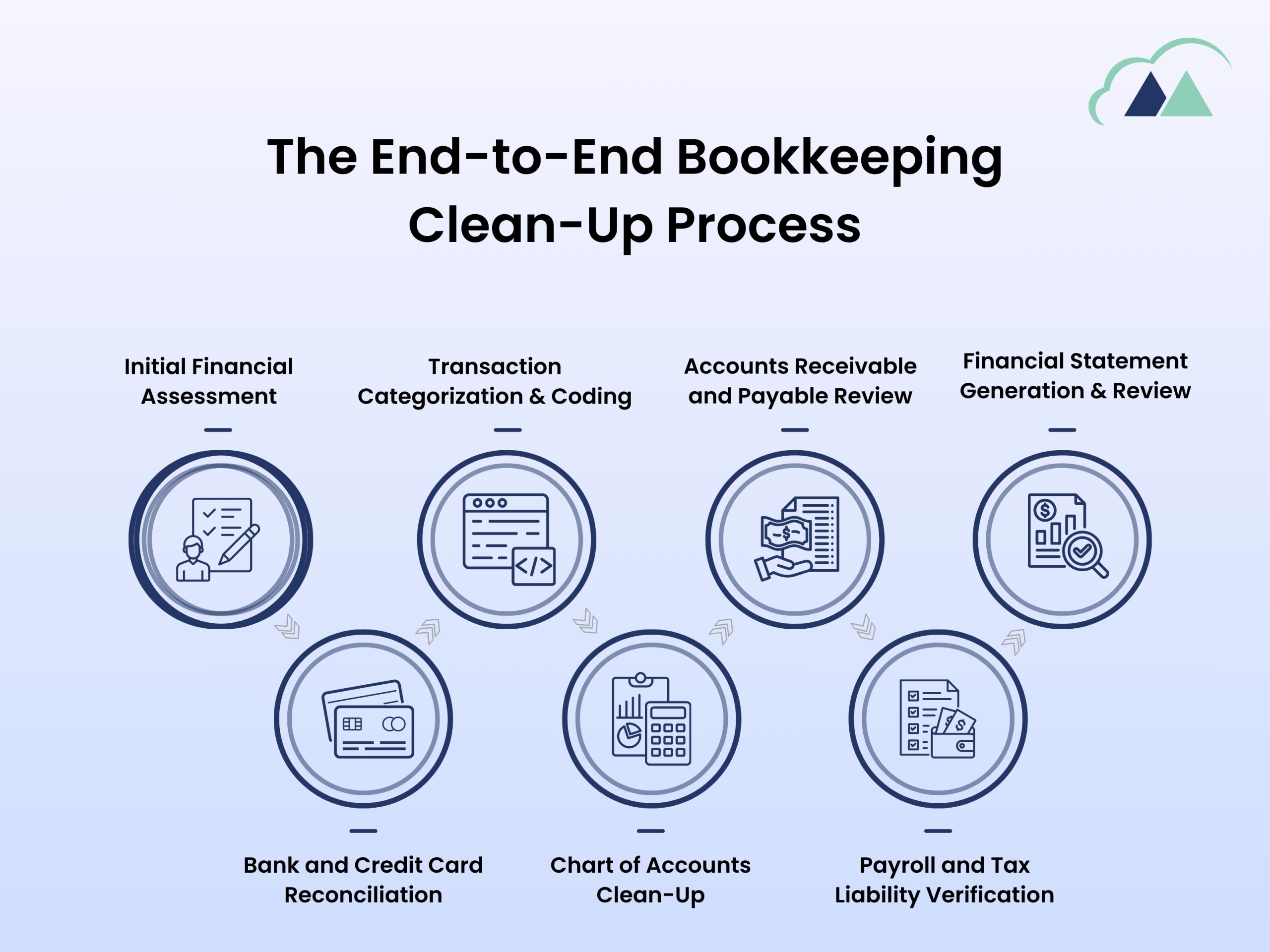
Step 1: Initial Financial Assessment
Every clean-up begins with a thorough audit of your existing records. This means reviewing:
- Your current Chart of Accounts
- Prior bank and credit card statements
- Outstanding invoices and bills
- Payroll records and tax filings
- Software setup and integration accuracy
This step identifies the scope of the clean-up and flags the most critical errors to address first.
Step 2: Bank and Credit Card Reconciliation
Reconciliation is the cornerstone of clean bookkeeping. Each bank account and credit card is matched by transaction against your accounting records. Any discrepancy missing deposits, duplicate charges, unrecorded expenses flagged and corrected.
Why it matters: Unreconciled accounts can lead to inaccurate tax filings, missed deductions, and cash flow problems you don’t even know exist.
Step 3: Transaction Categorization and Coding
Every transaction in your business needs to live in the right category. Misclassified expenses (e.g., labeling a software subscription as office supplies) can distort your financial reports and even cost you tax deductions.
During this phase, bookkeepers will:
- Review and reclassify mislabeled transactions
- Create or merge categories for clarity
- Apply consistent coding rules going forward
Step 4: Chart of Accounts Clean-Up
A bloated or improperly structured Chart of Accounts is a common source of confusion. This step involves:
- Removing redundant or unused accounts
- Adding missing categories relevant to your industry
- Organizing accounts in a tax-friendly hierarchy
- Aligning the structure with your CPA’s preferences
Step 5: Accounts Receivable and Payable Review
Old, uncollected invoices and unpaid bills don’t just look bad they directly affect your tax liability and cash flow. During this stage:
- Aged receivables are identified and flagged for follow-up
- Duplicate or erroneous bills are removed
- Outstanding vendor balances are verified
Step 6: Payroll and Tax Liability Verification
Payroll errors are among the most expensive to fix. Bookkeepers will verify:
- Payroll transactions are recorded accurately
- Employer tax liabilities are properly posted
- 941 filings, W-2s, or 1099s are correctly reflected in the books
Step 7: Financial Statement Generation and Review
Once the books are clean, accurate financial statements are generated:
- Profit & Loss Statement – Shows your true revenue and expenses
- Balance Sheet – Reflects your assets, liabilities, and equity
- Cash Flow Statement – Shows how money moved through your business
These documents become the foundation for your tax filing and future financial planning.
How Messy Books Hurt Your Business Beyond Tax Season
Many business owners think disorganized finances are just a tax-time headache. The reality is far more serious:
- Overpaying taxes: Without accurate expense tracking, you miss legitimate deductions and pay more than you owe.
- Poor business decisions: Inaccurate financial data leads to bad budgeting, overspending, or underpricing.
- Loan and funding rejections: Lenders require clean, up-to-date financials. Messy books can kill a funding application.
- IRS audit risk: Discrepancies between reported income and bank statements are a major audit trigger.
- Cash flow blind spots: You may think you’re profitable when you’re actually in trouble or vice versa.
DIY vs. Professional Bookkeeping Clean-Up: Which Is Right for You?
| Factor | DIY Clean-Up | Professional Service |
|---|---|---|
| Cost | Lower upfront | Higher upfront, lower long-term |
| Time Investment | Very high | Minimal for you |
| Accuracy | Risk of repeated errors | Guaranteed by experts |
| IRS Compliance | Uncertain | CPA-reviewed and reliable |
| Turnaround Time | Weeks to months | Days to weeks |
| Ongoing Support | Self-managed | Ongoing advisory available |
If your books are more than 3 months behind or involve payroll, multi-account reconciliation, or prior-year errors, a professional service is almost always the better investment.
How to Prevent Messy Books Going Forward
Cleaning up messy books once is helpful but preventing accounting issues in the future is even more important. Businesses can avoid financial confusion by following a few simple bookkeeping habits consistently. Reconciling accounts monthly, documenting every transaction, and separating personal and business finances can significantly reduce errors and missing records. Using reliable accounting software and scheduling regular financial reviews also helps maintain accurate books throughout the year.
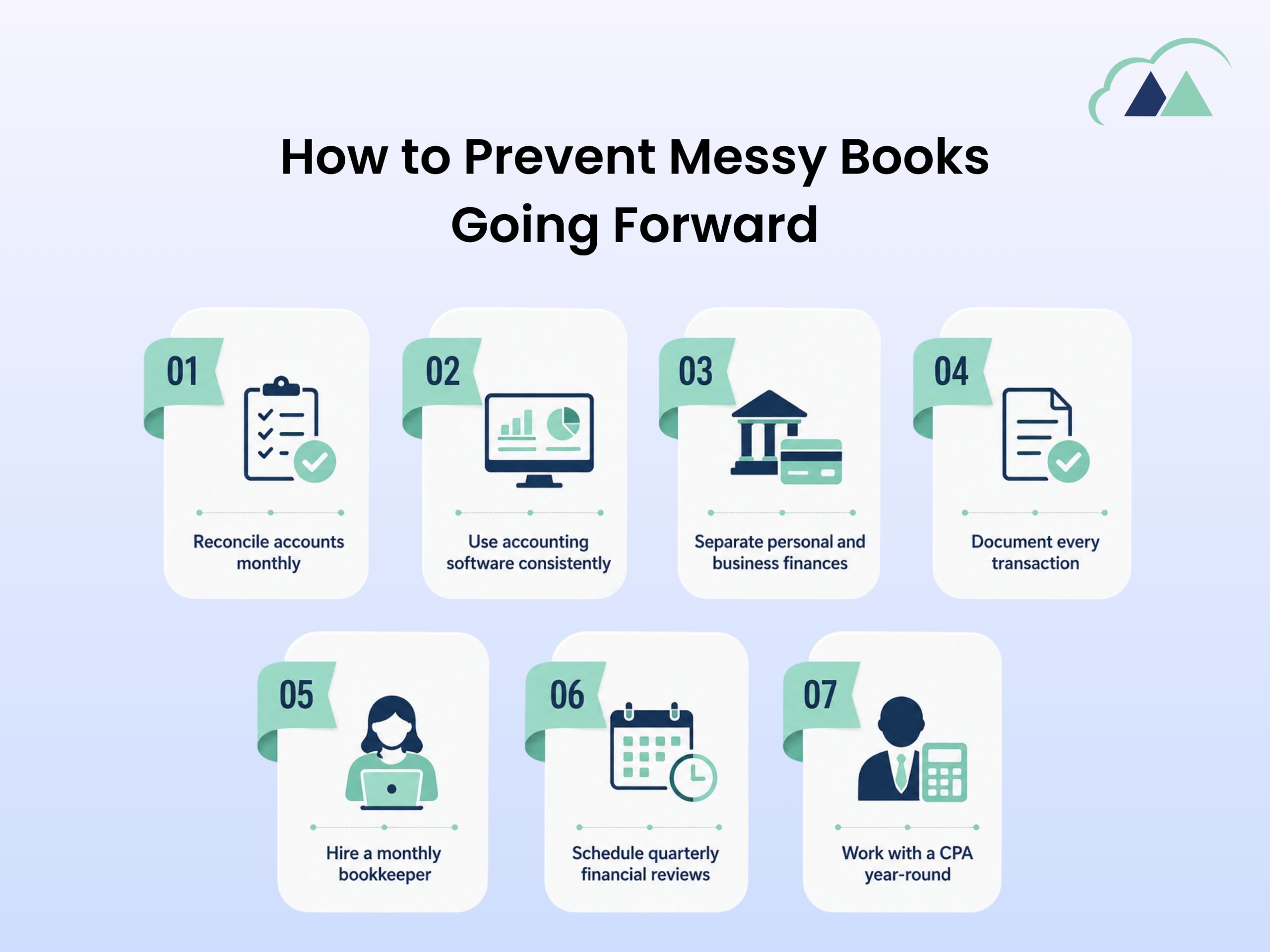
How to Prevent Messy Books Going Forward
- Reconcile accounts monthly
- Use accounting software consistently
- Separate personal and business finances
- Document every transaction
- Hire a monthly bookkeeper
- Schedule quarterly financial reviews
- Work with a CPA year-round
Following these best practices can help prevent accounting errors, reduce tax-season stress, and improve overall financial visibility. Consistent bookkeeping habits ensure your business stays compliant, financially healthy, and prepared for future growth.
What to Look for in a Bookkeeping Clean-Up Service Provider
Not all bookkeeping services are created equally. When evaluating providers, ask:
- Do they specialize in your accounting software? (QuickBooks, Xero, Wave, etc.)
- Do they have experience in your industry?
- Can they coordinate directly with your CPA or tax preparer?
- What is their timeline for completion?
- Do they offer ongoing monthly bookkeeping after the clean-up?
- Are their bookkeepers certified or credentialed?
- Do they provide a clear scope of work and fixed pricing?
A trustworthy provider will give you a transparent quote after reviewing your books not a one-size-fits-all package.
Why Madhda Inc Is the Right Partner for Your Bookkeeping Clean-Up
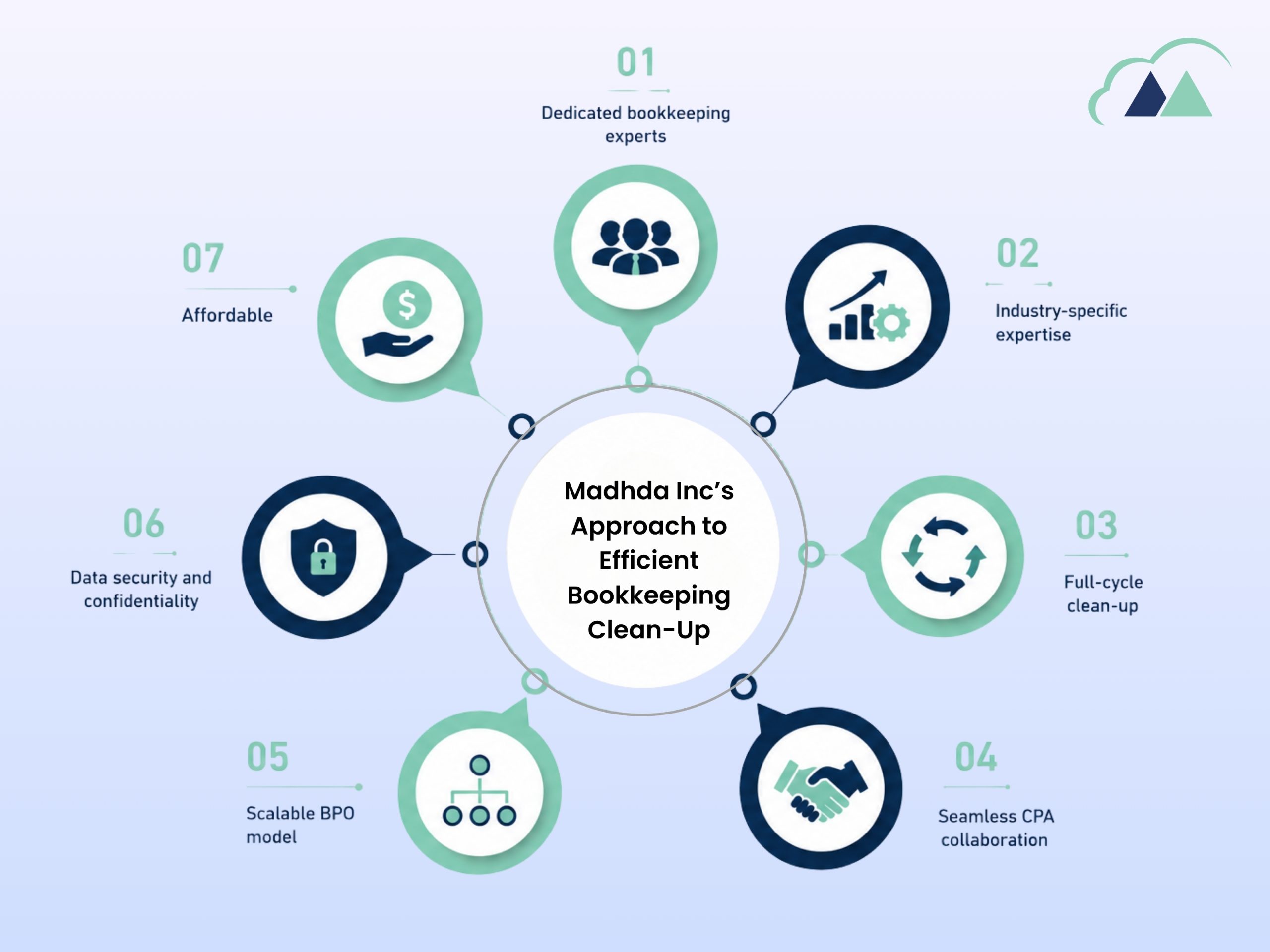
As a trusted BPO (Business Process Outsourcing) services provider, We’re specializes in delivering end-to-end bookkeeping clean-up services that are accurate, timely, and fully aligned with your tax and compliance requirements. Here’s what sets Madhda Inc apart:
✅ Dedicated bookkeeping specialists – trained in QuickBooks, Xero, and major accounting platforms
✅ Industry-specific expertise – across retail, healthcare, professional services, e-commerce, and more
✅ Full-cycle clean-up – from bank reconciliation to financial statement preparation handled under one roof
✅ Seamless CPA collaboration so your books are ready for filing without back-and-forth delays
✅ Scalable BPO model – whether you need a one-time clean-up or ongoing monthly bookkeeping support, Madhda Inc scales with your business
✅ Data security and confidentiality with strict protocols to protect your financial information
✅ Affordable, transparent pricing – no surprise fees, no long-term lock-ins
At Madhda Inc, we understand that your books are more than just numbers they’re the financial backbone of your business. Our team works efficiently and methodically to bring your records up to date, so you can file with confidence and focus on what you do best: growing your business.
Clean Books Are a Business Advantage
Tax season doesn’t have to be a financial fire drill. With the right bookkeeping clean-up service, you can walk into filing season with complete confidence knowing your numbers are accurate, your deductions are captured, and your financial statements tell the true story of your business.
More importantly, clean books aren’t just about compliance. They’re about making smarter decisions, accessing better financing, and building a business that’s financially resilient year-round.
Don’t let another tax season catch you off guard. The best time to fix your books was last year. The second-best time is right now.
Looking for a trusted bookkeeping clean-up partner? Work with Madhda BPO certified professionals who understand your industry, your software, and your goals so you can get back to running your business with confidence.