
 LinkedIn
  You-tube


Is Your Inventory Accounting Costing Profit?
Imagine losing thousands of dollars every month because your inventory system can’t keep up with your business. Overstocked warehouses consuming cash. Stockouts costing you sales. Manual spreadsheets packed with errors. GAAP compliance headaches. This isn’t a hypothetical – it’s the reality for many US businesses still relying on outdated inventory accounting methods.
The challenge is real: managing inventory accounting has become exponentially more complex. Modern US businesses juggle multiple sales channels, sophisticated regulatory requirements, and pressure to reduce costs while maintaining growth.
Yet most companies continue using manual processes designed for simpler times.
What if there was a better way?
Artificial Intelligence and machine learning technologies are revolutionizing inventory accounting for forward-thinking US businesses. These intelligent systems eliminate manual errors, ensure regulatory compliance, and provide real-time insights that drive profitable decisions.
In this comprehensive guide, you’ll discover:
- How AI-powered inventory accounting works and why it matters for your bottom line
- The specific benefits that translate to measurable financial improvement
- Implementation strategies that minimize disruption and maximize ROI
- Real-world results from businesses that have made the transition
- Essential questions answered to clarify your decision-making
By the end of this article, you’ll understand exactly how AI-powered inventory accounting can transform your business operations and position your company for growth.
The Current State of Inventory Accounting: Problems Your Team Faces Daily
Before exploring solutions, let’s acknowledge the problems most businesses face with traditional inventory accounting:
1. Manual Data Entry Creates Systematic Errors
Your finance team spends hours entering inventory data manually. Each transaction creates an opportunity for error—typos, misclassifications, duplicate entries. These aren’t intentional mistakes; they’re inevitable consequences of human-dependent processes.
The cost: One study found that companies with manual inventory systems experience error rates between 3-8%, directly impacting financial accuracy and audit outcomes.
2. Delayed Financial Visibility
Monthly or quarterly reporting cycles mean your leadership team makes decisions based on stale data. By the time you realize inventory levels are wrong, the damage is already done.
The consequence: Stockouts happen because you didn’t see demand signals early enough. Excess inventory accumulates because forecasts were based on outdated information.
3. GAAP Compliance Creates Ongoing Stress
Generally Accepted Accounting Principles require consistent inventory valuation methods and meticulous documentation. Non-compliance risks audit failures, restatements, and regulatory scrutiny.
The reality: Finance teams spend disproportionate time ensuring GAAP compliance, pulling them away from strategic analysis.
Reconciliation Nightmares
Physical inventory counts never match system records. The discrepancies should be investigated immediately, but most businesses don’t have the resources. These unresolved variances hide inefficiencies, theft, and process failures.
The impact: You don’t actually know your real inventory costs or profitability.
4. Limited Forecasting Capability
Traditional systems can’t predict future demand accurately. Historical data stays trapped in spreadsheets rather than informing decisions. This leads to constant inventory imbalances.
Understanding AI-Powered Inventory Accounting: How It Works
AI-powered inventory accounting combines three core technologies:
1. Artificial Intelligence & Machine Learning
Algorithms that learn from your historical data, identify patterns, and make increasingly accurate predictions about inventory needs, costs, and financial impact.
2. Automation & Integration
Systems that automatically capture transactions from all data sources ERP systems, e-commerce platforms, point-of-sale systems, warehouse management software and consolidate them into a single source of truth.
3. Real-Time Analytics
Dashboards and reporting systems that provide instant visibility into inventory levels, costs, profitability, and compliance status. When combined, these technologies create a system that works 24/7 to ensure inventory accuracy, compliance, and profitability.
How It Differs From Traditional Inventory Accounting
| Aspect | Traditional Method | AI-Powered System |
|---|---|---|
| Data Entry | Manual, spreadsheet-based | Automated from multiple sources |
| Reporting Frequency | Monthly or quarterly | Real-time, continuous |
| Error Detection | Delayed, after-the-fact | Immediate, before posting |
| Compliance Risk | High (human-dependent) | Low (systematic controls) |
| Forecasting Accuracy | Limited to historical averages | Advanced machine learning |
| Time Investment | 20-40 hours per week | 2-5 hours per week |
Why Now? The Market is Demanding Change
Several factors are making AI-powered inventory accounting essential rather than optional:
E-Commerce Growth
Online sales channels create unprecedented complexity. Traditional systems weren’t designed to handle real-time inventory synchronization across multiple platforms.
Regulatory Tightening
Auditors and regulators increasingly expect systematic controls. Manual processes no longer meet audit expectations.
Supply Chain Volatility
Recent global supply chain disruptions have shown that businesses need real-time inventory visibility to respond quickly.
Competitive Pressure
Competitors who adopt AI-powered accounting gain advantages in profitability, cash flow, and decision speed. Staying with manual methods puts you at disadvantage.
Cost Pressures
CFOs are under pressure to do more with less. Automation is no longer a luxury. it’s how efficient finance teams operate.
The Benefits: How AI-Powered Inventory Accounting Transforms Your Business
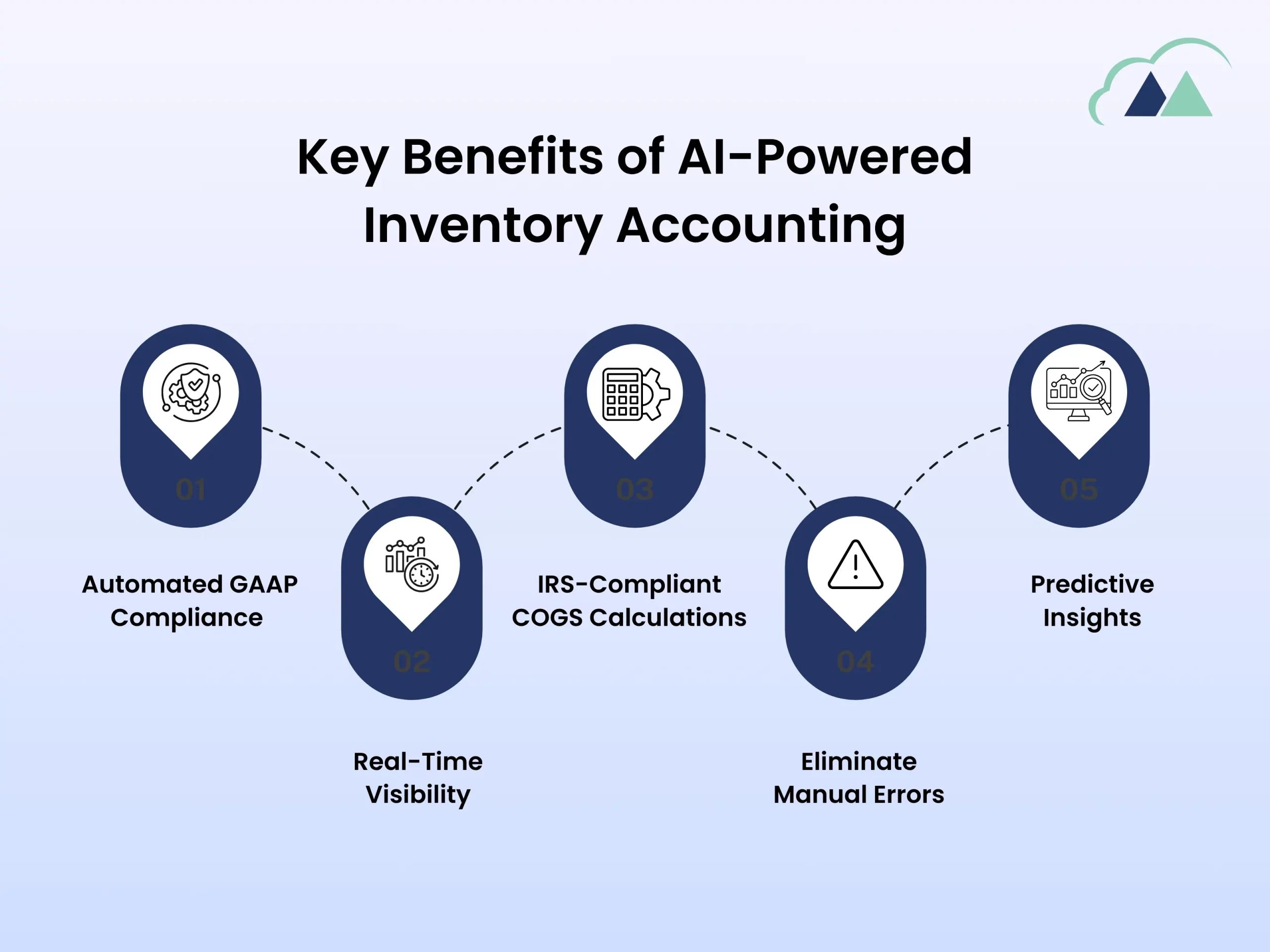
Benefit #1: Automated GAAP Compliance Without the Headaches
The Problem:
GAAP inventory accounting rules are complex. Different products might require different valuation methods. Reconciliations take weeks. Auditors find issues that management wasn’t aware of. Non-compliance risks restatements and regulatory penalties.
How AI Solves It:
AI systems are built with GAAP compliance embedded in their architecture. They automatically:
- Apply consistent valuation methods across all transactions (FIFO, LIFO, weighted average)
- Generate compliant journal entries without human intervention
- Maintain complete audit trails documenting every transaction, user action, and approval
- Calculate lower-of-cost-or-market adjustments where permitted by GAAP
- Produce audit-ready reports that meet auditor expectations on the first request
Real Impact:
Companies report 40-60% faster audit cycles. More importantly, auditors stop finding GAAP-related issues because the system ensures compliance automatically.
The Financial Benefit: Reduce audit costs by 20-30% and eliminate the risk of restatements that damage credibility.
Benefit #2: Real-Time Visibility Into Your True Financial Position
The Problem:
Your CFO needs to know current inventory value, COGS, and profitability. But financial reports come out weeks after period-end. By then, decisions have already been made based on incomplete information.
How AI Solves It:
Real-time inventory accounting systems provide:
- Live dashboards showing current inventory balances, values, and movements across all locations
- Instant reconciliation comparing physical counts, transaction records, and system balances automatically
- Daily variance reports identifying discrepancies within hours rather than weeks
- Multi-location consolidation pulling data from all warehouses and retail locations automatically
- Channel integration synchronizing data from e-commerce, POS, ERP, and other systems automatically
What This Means Operationally:
When you ask “How much inventory are we carrying right now?” you get an accurate answer immediately. When a physical count doesn’t match system records, you know within 24 hours.
Real Impact:
Companies reduce stockouts by 35-50% because they see demand signals in real-time. Excess inventory decreases by 25-40% because stock levels can be optimized continuously.
The Financial Benefit: Reduce carrying costs by $50,000-$200,000+ annually depending on your inventory investment. Improve cash flow by keeping capital deployed more efficiently.
Benefit #3: IRS-Compliant COGS Calculations That Pass Tax Audits
The Problem:
The IRS has strict requirements for how COGS must be calculated and documented. Different valuation methods (FIFO, LIFO, weighted average) produce different tax outcomes. Mistakes on tax returns trigger audits and penalties. Documentation requirements are extensive.
How AI Solves It:
AI inventory systems ensure IRS compliance by:
- Accurately tracking all costs attributable to inventory (purchase price, freight, handling, labor)
- Supporting multiple valuation methods so you can choose the approach that optimizes your tax position
- Maintaining complete documentation that the IRS expects during audits
- Generating tax-ready COGS schedules that reconcile to your tax return
- Identifying tax optimization opportunities within compliance guidelines (lower-of-cost-or-market, inventory reserves)
Tax Planning Advantage:
Understand your tax position clearly during the year, not at year-end. This enables proactive tax planning rather than reactive scrambling.
Real Impact:
Avoid costly tax adjustments and penalties. Many companies have discovered they’ve been overpaying taxes due to inventory valuation method selection.
The Financial Benefit: Tax savings often pay for the system in a single year while eliminating audit risk entirely.
Benefit #4: Eliminate Manual Errors That Cost Thousands Monthly
The Problem:
Manual inventory accounting is error-prone by nature. Data entry mistakes, transposition errors, missed transactions, and duplicate postings are inevitable. These errors compound monthly, creating significant variances between physical inventory and system records.
How AI Solves It:
Automation eliminates errors by:
- Removing manual data entry entirely—transactions flow automatically from source systems to the ledger
- Preventing duplicate transactions through systematic deduplication before posting
- Catching errors before they post through automated validation and exception handling
- Eliminating transposition errors (computers don’t mistype numbers)
- Creating systematic controls that prevent entire categories of errors
What This Means for Your Team:
Your finance team shifts from data entry and error correction to analysis and planning. This improves both accuracy and employee satisfaction.
Real Impact:
Inventory accuracy improves from 85-92% (typical with manual systems) to 99%+ with AI systems.
The Financial Benefit: Your team gains 30-50 hours per week currently spent on manual tasks. That’s approximately 1.5-2 additional FTEs worth of capacity freed up for higher-value work.
Benefit #5: Predictive Insights That Optimize Inventory Decisions
The Problem:
Traditional inventory systems provide historical data. You know what happened last month. You don’t know what’s coming next. Demand forecasting relies on guesswork or simple averages, leading to constant imbalances between supply and demand.
How AI Solves It:
Machine learning algorithms analyze vast data sets to provide:
- Demand forecasting by product, location, and time period using multiple predictive models
- Optimal inventory level recommendations balancing availability risk against carrying costs
- Obsolescence prediction identifying slow movers before they become worthless
- Seasonal adjustment automatically accounting for seasonal patterns in demand
- Supplier performance insights tracking reliability and quality to optimize purchasing
Practical Examples:
- Retailer identifies that specific products have predictable demand spikes in certain seasons, automatically increasing stock before peak periods
- E-commerce company predicts which SKUs will become obsolete in Q3, adjusting purchasing to minimize write-offs
- Distributor sees early warning that customer demand is decreasing, reducing orders before excess inventory accumulates
Real Impact:
Inventory write-offs and obsolescence decrease by 20-35%. Stockout frequency decreases by 35-50%.
The Financial Benefit: Better inventory optimization improves cash flow by $100,000-$500,000+ annually, depending on your inventory investment level.
Essential Features: What to Look for in an AI Inventory Accounting System
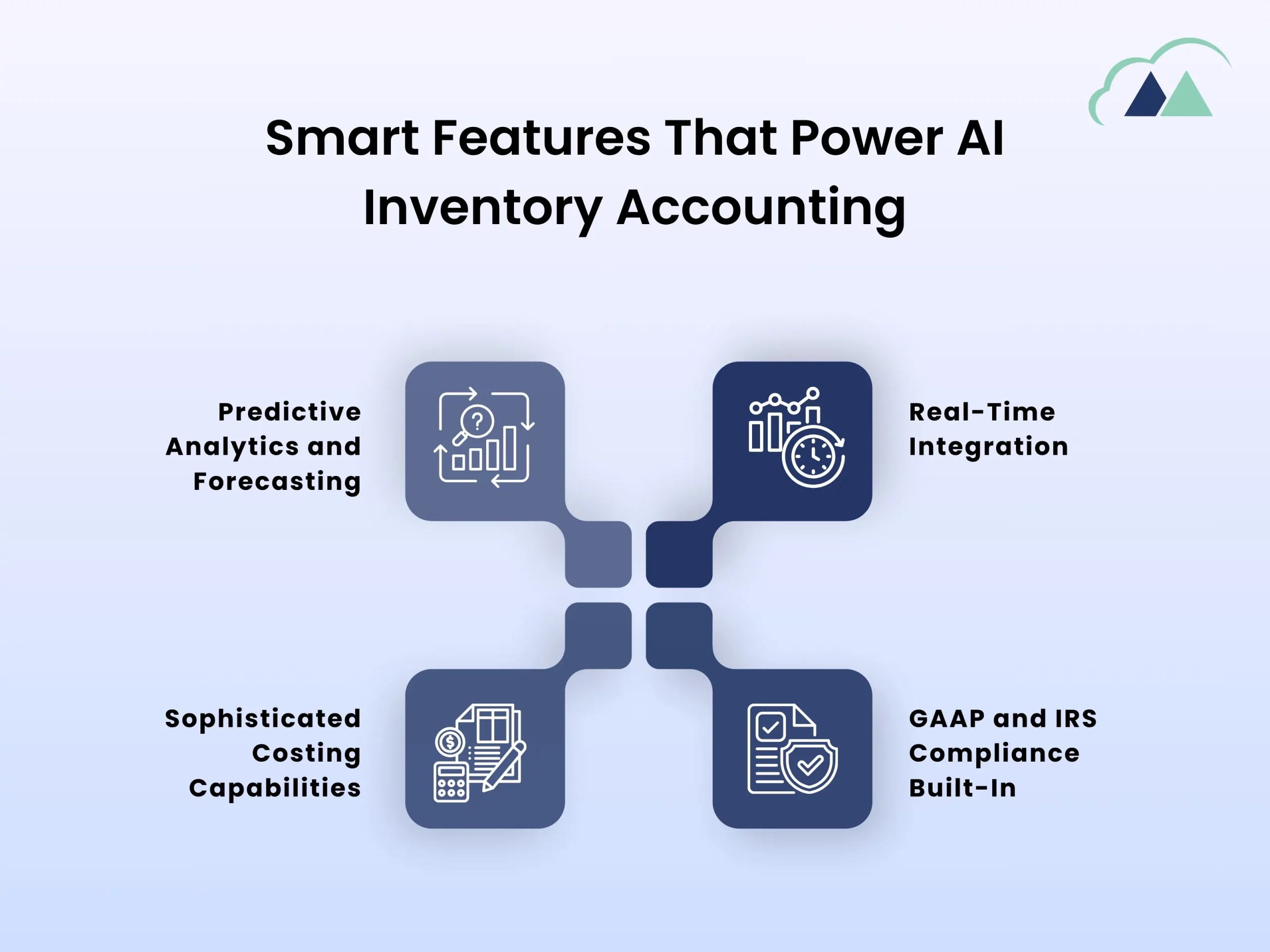
Must-Have Capability #1: Real-Time Integration
Your AI system must connect seamlessly to your existing technology ecosystem:
- API-based architecture connecting to ERP, e-commerce, POS, and WMS systems
- Bi-directional synchronization ensuring data flows both ways
- Support for custom integrations for specialized systems
- Cloud-native design for reliability and scalability
Why This Matters:
If the system can’t integrate with your existing tools, you’ll face manual data transfer, inconsistencies, and higher implementation costs.
Must-Have Capability #2: GAAP and IRS Compliance Built-In
Compliance can’t be an afterthought:
- Embedded GAAP standards in the system architecture
- Multiple valuation method support (FIFO, LIFO, weighted average, specific identification)
- Automated audit trail creation documenting every transaction
- Compliance reporting templates meeting auditor expectations
Why This Matters:
A non-compliant system creates more problems than it solves. You need compliance embedded, not bolted on.
Must-Have Capability #3: Sophisticated Costing Capabilities
The system must handle your industry’s specific costing requirements:
- Landed cost calculation including freight and duties
- Multi-currency support if you operate internationally
- Variance analysis identifying cost deviations
- Flexible cost allocation supporting your business model
Why This Matters:
Generic systems won’t handle the complexity of your business. You need capabilities tailored to your industry.
Must-Have Capability #4: Predictive Analytics and Forecasting
The system should provide intelligence, not just reporting:
- Demand forecasting using machine learning
- Inventory optimization recommendations
- Obsolescence prediction identifying slow movers
- Seasonal adjustment built into forecasts
Why This Matters:
This is where real financial benefits happen better decisions based on better information.
AI-powered inventory accounting isn’t a nice-to-have technology anymore, it’s becoming a competitive necessity for US businesses serious about profitability and growth.
The businesses thriving in 2026 aren’t necessarily the ones with the largest budgets. They’re the ones who recognized that AI can transform accounting from a source of stress and error into a source of competitive advantage.
The best time to implement AI inventory accounting was two years ago. The second-best time is today.
Your competitors aren’t waiting. Your opportunity to gain competitive advantage through better financial intelligence won’t last forever.
Ready to Transform Your Inventory Accounting?
Take the first step today. Schedule a conversation with our team about your biggest inventory accounting challenges. Then reach out to a vendor to learn how AI-powered solutions can address them.
The CFOs and finance leaders moving first will capture the greatest benefits. Don’t let your business remain stuck in manual processes while competitors pull ahead.