
 LinkedIn
  You-tube



External Financial Audit Checklist at a Glance
Preparing for an external financial audit involves more than gathering financial statements at the last minute. A successful audit requires accurate bookkeeping, reconciled accounts, organized supporting documents, strong internal controls, and clear communication with auditors. By following a structured audit preparation checklist, businesses can reduce delays, improve compliance, and complete audits more efficiently.
Does the word “audit” make your stomach drop the moment it lands in your inbox? If so, you’re in good company. For most business owners and finance teams, an external financial audit feels like a pop quiz you didn’t know was coming even though it shows up on the calendar every single year. Here’s the truth, though: audits aren’t designed to catch you off guard. They’re a structured, predictable process, and with the right groundwork, they can go from a weeks-long scramble to a smooth, almost routine exercise.
In this guide, we’ll walk you through a practical, step-by-step checklist to get your books, documents, and team audit-ready long before the auditors walk through the door. By the time you finish reading, you’ll know exactly what to prepare, when to start, and how to sidestep the last-minute chaos that trips up so many growing businesses. And if you’d rather hand off the heavy lifting of bookkeeping, reconciliations, and financial reporting altogether, Madhda Inc’s accounting and BPO team can help you stay audit-ready all year round not just when the auditors call.
What Is an External Financial Audit, and Why Does It Matter?
An external financial audit is an independent examination of your company’s financial statements, carried out by a licensed auditor who has no stake in your business. Their job is simple to describe but demanding to deliver: confirm whether your financial statements present a true and fair view of your company’s financial position, free of material misstatement.
Beyond the compliance checkbox, a clean audit opinion does real work for your business. It builds credibility with investors and lenders, satisfies regulatory and tax requirements, and gives your leadership team an independent, unbiased read on the health of the business. Skip the preparation, though, and the same audit can turn into weeks of back-and-forth emails, ballooning professional fees, and a report full of avoidable findings.
Who Typically Needs an External Audit?
You might assume audits are only for large corporations, but that’s not the case anymore. External audits are commonly required for:
- Public companies and businesses preparing for an IPO
- Companies with bank loans, credit facilities, or investor covenants that require audited financials
- Nonprofits meeting certain funding or grant thresholds
- Businesses in regulated industries or specific free zones and jurisdictions with mandatory audit requirements
- Startups raising institutional funding, where audited financials build investor trust
Even if an audit isn’t legally mandatory for your business yet, having audit-ready books puts you in a stronger position the moment a lender, investor, or regulator asks for one.
When Should You Start Preparing for an Audit?
The short answer: earlier than you think. Audit readiness isn’t a one-week sprint it’s a habit built into your monthly close process. That said, if you’re working backward from a fixed audit date, here’s a realistic timeline:
- 90 days out – Confirm your audit firm, sign the engagement letter, and assign an internal audit coordinator.
- 60 days out – Close and reconcile the prior period’s books, and start compiling supporting documentation.
- 30 days out – Complete an internal pre-audit review, resolve open items from last year’s management letter, and confirm your document repository is ready to share.
- 1–2 weeks out – Do a final walkthrough with your team, confirm auditor access, and schedule kickoff and status meetings.
The Step-by-Step External Audit Preparation Checklist
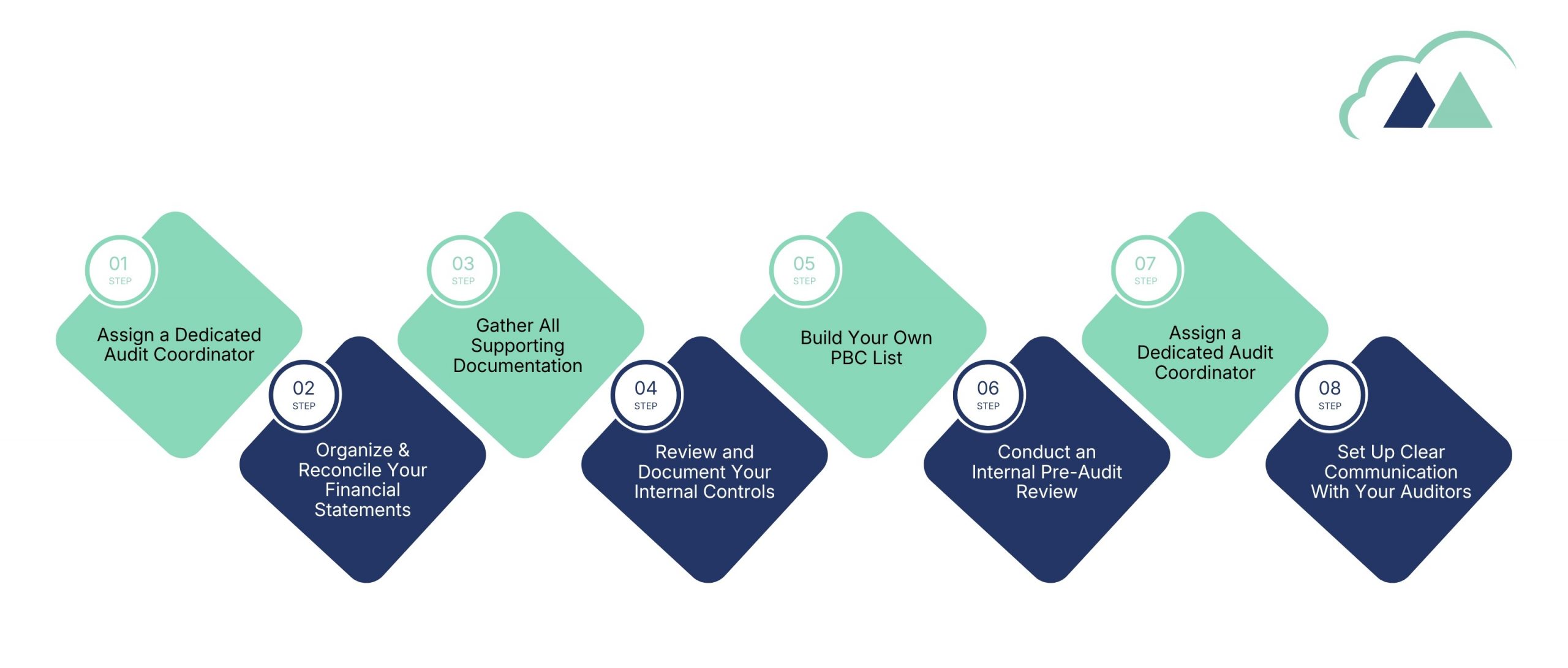
1. Assign a Dedicated Audit Coordinator
Every smooth audit has one thing in common: a single point of contact who owns the process. This person usually a controller, finance manager, or outsourced accounting partner tracks document requests, chases down answers, and keeps the auditor’s questions from getting lost between departments. Without this role, requests multiply, deadlines slip, and nobody is quite sure who’s responsible for what.
2. Organize and Reconcile Your Financial Statements
Your books need to be closed, accurate, and reconciled before fieldwork starts not during it. This includes:
- Balance sheet, income statement, and cash flow statement
- Bank and credit card reconciliations for every account
- Accounts receivable and accounts payable aging reports
- Payroll records reconciled against tax filings
- Fixed asset and depreciation schedules
- Intercompany accounts (if applicable), reconciled to the penny
Even small, unexplained variances tend to snowball into detailed testing, so it pays to catch them yourself first.
3. Gather All Supporting Documentation
Auditors verify what your numbers claim by tracing them back to source documents. Start compiling:
- Sales and purchase invoices, receipts, and contracts
- Vendor and customer agreements
- Loan documents and lease agreements
- Tax filings and correspondence with tax authorities
- Board meeting minutes and resolutions
- Prior-year audit report and management letter
Store everything in one centralized, well-labeled digital folder rather than scattered across inboxes and desktops. This alone can shave significant time off the engagement.
4. Review and Document Your Internal Controls
Auditors don’t just test numbers they evaluate the systems and approvals behind them. Make sure you can clearly show:
- Segregation of duties across key financial processes
- Documented approval workflows for expenses and payments
- Access controls for your accounting software
- Consistent application of your accounting policies throughout the year
If anything changed mid-year a new approval process, a new accounting policy document the change and its financial impact clearly.
5. Build Your Own PBC (Prepared-by-Client) List
Your auditor will send a formal PBC list at kickoff, but preparing your own version in advance is a signal of strong financial management and it helps you catch missing documents before the clock starts. Map out every item, who owns it, where it’s stored, and the expected delivery date.
6. Conduct an Internal Pre-Audit Review
Before the external team arrives, run your own review of high-risk areas: revenue recognition, inventory valuation, related-party transactions, and any unusual or judgment-heavy entries. Fixing issues internally is always faster and cheaper than having an auditor flag them for you.
7. Set Up Clear Communication With Your Auditors
Schedule a planning meeting before fieldwork begins to align on scope, timeline, and problem areas. Keep the conversation going with brief, regular status check-ins throughout the engagement so you can address questions as they come up rather than all at once at the end.
What Are the Most Common Mistakes That Slow Down an External Financial Audit?
- Treating audit prep as a last-minute, once-a-year scramble instead of an ongoing habit
- Sending disorganized or incomplete documentation
- Skipping reconciliations until the auditor asks for them
- Having no single point of contact for auditor requests
- Leaving prior-year findings unresolved
- Underestimating how long document collection actually takes
The Real Benefits of Being Audit-Ready
Audit preparation isn’t just about surviving the process it pays dividends well beyond the final report:
- Faster audits with fewer professional fees
- Stronger internal controls and cleaner books year-round
- Greater credibility with banks, investors, and regulators
- Early visibility into financial risks before they become bigger problems
Stop Scrambling at Audit Time – Stay Ready All Year.
Madhda Inc.’s bookkeeping, reconciliation, and Virtual CFO team keeps your books audit-ready every month – so your next audit is a folder share, not a fire drill.
Call: USA +1 (302) 303-9860 | IND +91 97242 42267 | Email: sales@madhda.com
How Madhda Inc Can Help You Stay Audit-Ready All Year
Here’s the part most businesses underestimate: audit readiness isn’t built in the 30 days before fieldwork it’s built every month, in the way your books are maintained. That’s exactly where Madhda Inc’s BPO services come in.
Our accounting, bookkeeping, and Virtual CFO teams handle the groundwork that makes audits painless: monthly reconciliations, clean chart-of-accounts management, payroll accuracy, and organized documentation, maintained continuously rather than assembled in a panic. Whether you need ongoing bookkeeping support, tax preparation, or a Virtual CFO to oversee your financial reporting, Madhda Inc’s BPO team works as an extension of your finance function, so that when audit season arrives, you’re not scrambling you’re simply sharing a folder that’s already been ready for months.
Ready to make your next audit the smoothest one yet?
Talk to Madhda Inc’s accounting and BPO team today and find out how outsourced bookkeeping, payroll, and Virtual CFO support can keep your business audit-ready, every single day of the year.