
 LinkedIn
  You-tube


Are you spending more time reconciling accounts and chasing missing receipts than actually advising your clients and growing your CPA firm?
If you answered yes, you’re not alone. Thousands of CPA firms across the United States are silently drowning in bookkeeping backlogs not because they lack talent, but because they’re stretched too thin. The good news? There’s a smarter way to run your practice.
Bookkeeping outsourcing services for CPA firms have transformed the way accounting practices operate, helping them cut costs, eliminate bottlenecks, and deliver faster, more accurate results to clients. In this blog, you’ll discover exactly what outsourced bookkeeping is, why it’s the #1 growth strategy for CPA firms in 2026, what services are included, and how to choose the right partner. By the end, you’ll have everything you need to make a confident, informed decision.
What Is Bookkeeping Outsourcing for CPA Firms?
Bookkeeping outsourcing means hiring an external team either onshore or offshore to handle the day-to-day financial record-keeping tasks on behalf of your CPA firm or your firm’s clients. Instead of hiring, training, and managing full-time in-house staff, you delegate the work to a specialized provider who operates as an extension of your team.
This can include:
- Recording daily financial transactions
- Reconciling bank and credit card statements
- Managing accounts payable and receivable
- Preparing monthly financial reports
- Maintaining the general ledger
- Processing payroll entries
Many outsourcing providers also offer white-label bookkeeping, meaning the work is delivered under your firm’s brand, so your clients never know the work is being done externally.
Why CPA Firms in the USA Are Choosing to Outsource Bookkeeping
The accounting industry in the United States is undergoing a significant shift. According to the AICPA, the talent shortage in accounting is at an all-time high, with fewer graduates choosing CPA careers. At the same time, client expectations are rising. Here’s why more CPA firms are turning to outsourced bookkeeping:
1. Severe Staffing Shortages
Recruiting and retaining qualified bookkeepers in the USA is increasingly difficult and expensive. Outsourcing gives you instant access to a trained, ready-to-deployed team without the hassle of hiring.
2. Significant Cost Savings
Employing a full-time in-house bookkeeper in the US can cost between $50,000 to $75,000 per year when you factor in salary, benefits, taxes, and overhead. Outsourced bookkeeping services typically cost a fraction of that, often 40–60% less.
3. Scalability on Demand
Tax season comes with a surge in the workload. Outsourcing lets you scale up or down instantly without the risks of overstaffing or layoffs. You pay for what you need when you need it.
4. Focus on Higher-Value Advisory Work
When your team isn’t buried in data entry and reconciliations, they can focus on what truly grows in your firm: financial planning, tax strategy, and client advisory services – the high-margin work that clients value most.
5. Access to Advanced Technology
Top outsourcing providers use industry-leading platforms like Business Central,QuickBooks Online, Xero, Sage, and NetSuite – often with certifications and expertise your in-house team may not have.
Core Bookkeeping Outsourcing Services for CPA Firms
Here’s a breakdown of the most common services included in an outsourced bookkeeping engagement:
General Ledger Maintenance
Accurate, up-to-date ledger management that forms the foundation of every financial report.
Bank & Credit Card Reconciliation
Monthly reconciliation of all accounts to ensure records match actual bank statements — eliminating errors and discrepancies.
Accounts Payable (AP) Management
Processing vendor invoices, scheduling payments, and ensuring suppliers are paid on time to maintain healthy vendor relationships.
Accounts Receivable (AR) Management
Invoicing clients, tracking outstanding payments, and following up on overdue accounts to improve cash flow.
Payroll Processing Support
Recording payroll journal entries, tracking employee compensation, and maintaining payroll-related compliance records.
Financial Statement Preparation
Monthly, quarterly, and annual preparation of: – Balance sheets – Income statements (Profit & Loss) – Cash flow statements
Catch-Up & Clean-Up Bookkeeping
Fixing months or even years of messy or incomplete books — a lifesaver for firms inheriting disorganized client accounts.
Tax-Ready Bookkeeping
Organizing financial records specifically in preparation for tax filing making your tax season smoother and faster.
White-Label Bookkeeping
Delivering all work under your CPA firm’s branding perfect for firms that want to expand their service offering without adding headcounts.
Key Benefits of Outsourcing Bookkeeping for CPA Firms
| Benefit | In-House Bookkeeping | Outsourced Bookkeeping |
|---|---|---|
| Cost | High ($50K–$75K/year) | Low (40–60% savings) |
| Scalability | Limited | Flexible & instant |
| Expertise | Varies | Specialized & certified |
| Technology | Basic | Advanced tools & integrations |
| Availability | Business hours only | Extended or 24/7 options |
| Risk | High (turnover, errors) | Managed & accountable |
How Outsourced Bookkeeping Works: Step-by-Step Process
Understanding the workflow helps you set the right expectations before onboarding a provider.
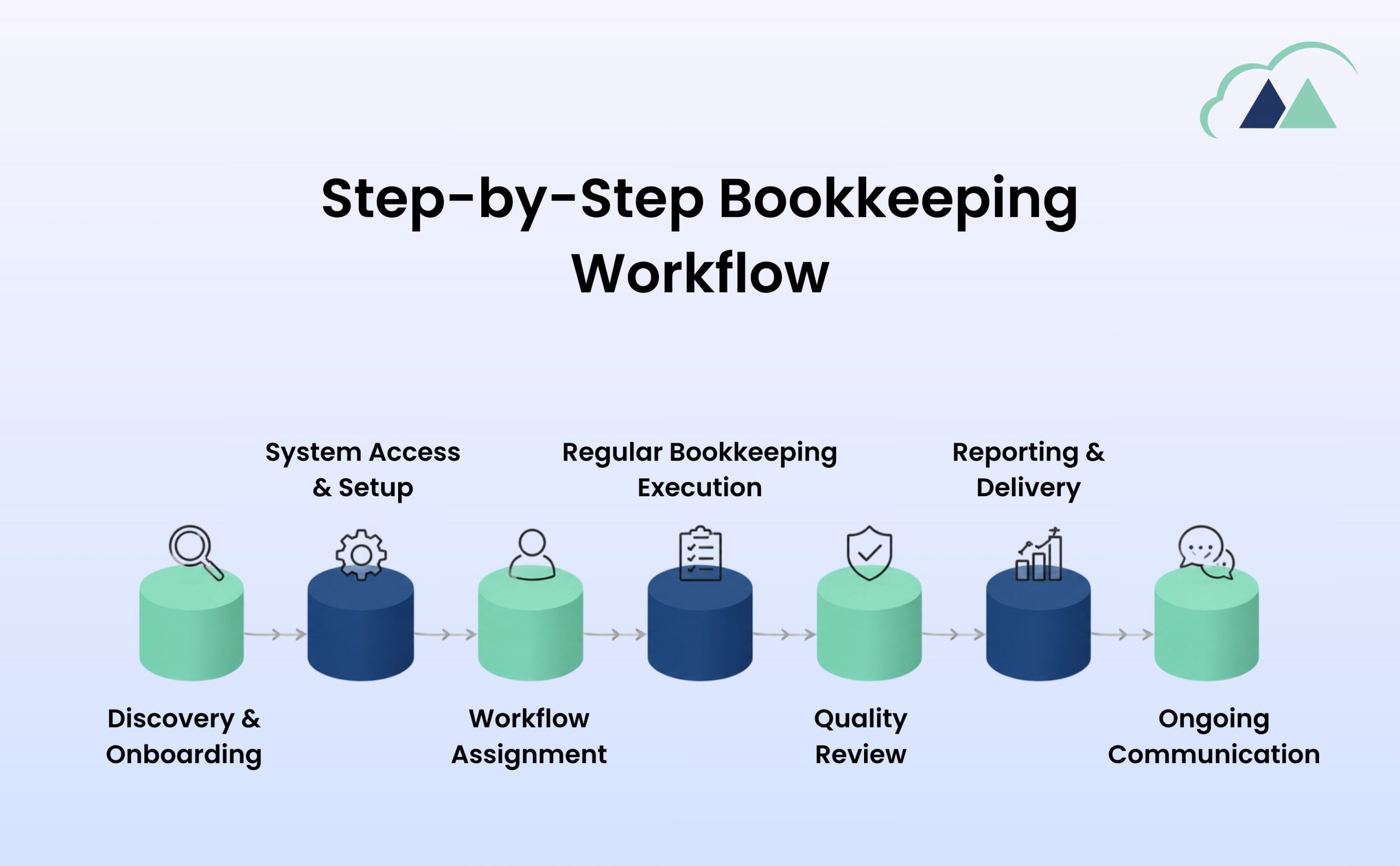
- Discovery & Onboarding — The outsourcing team reviews your current bookkeeping processes, software, and client requirements.
- System Access & Setup — Secure, role-based access is granted to your accounting platforms (QuickBooks, Xero, etc.).
- Workflow Assignment — Work is assigned to dedicated bookkeeping professionals aligned to your firm’s standards.
- Regular Bookkeeping Execution — Daily, weekly, or monthly tasks are completed per agreed timelines.
- Quality Review — A senior reviewer checks all work before delivery to ensure accuracy.
- Reporting & Delivery — Clean, reviewed financials are delivered to you or directly to your clients.
- Ongoing Communication — Regular check-ins, queries, and updates are managed through your preferred channel (email, Slack, PM tools).
What to Look for When Choosing a Bookkeeping Outsourcing Partner for Your CPA Firm
Not all outsourcing providers are created equally. Here are the critical factors to evaluate:
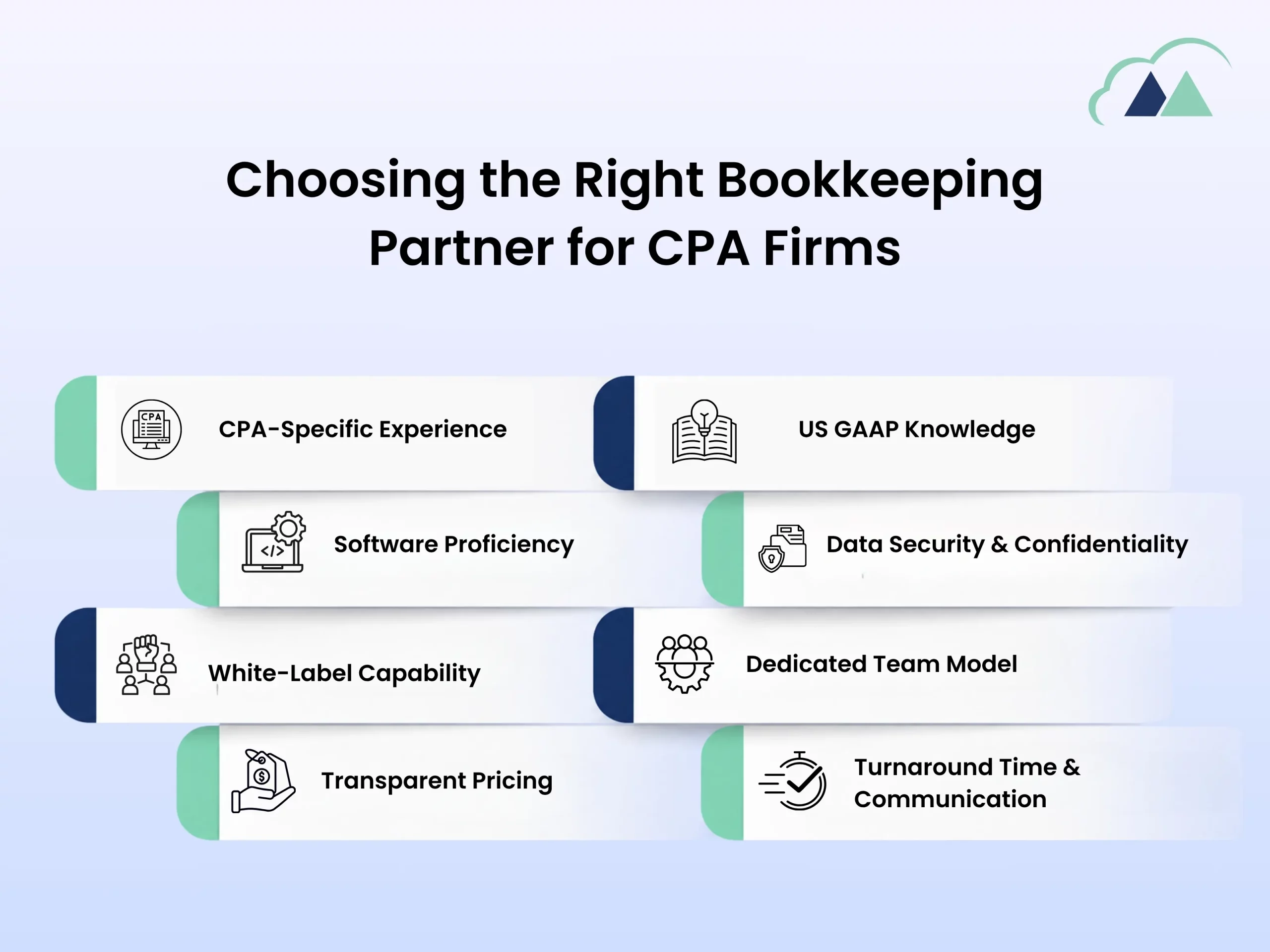
CPA-Specific Experience
Look for providers who specialize in working with CPA firms — not just general bookkeeping agencies. They’ll understand your workflows, turnaround expectations, and compliance requirements.
US GAAP Knowledge
Ensure the team is well-versed in US Generally Accepted Accounting Principles (GAAP) and familiar with IRS regulations and American tax standards.
Software Proficiency
Your provider should be certified or highly proficient in the tools your firm already uses — whether that’s QuickBooks, Xero, Sage, Wave, or NetSuite.
Data Security & Confidentiality
Ask about their data security protocols — including NDA agreements, encrypted data transfer, SOC 2 compliance, and role-based access controls. Client financial data is extremely sensitive.
White-Label Capability
If you want to resell bookkeeping services to your clients under your brand, confirm the provider supports white-label delivery.
Dedicated Team Model
Avoid providers who rotate bookkeepers constantly. A dedicated team or point of contact ensures consistency, familiarity with your clients, and fewer errors over time.
Transparent Pricing
Whether it’s hourly, per-transaction, or monthly flat-rate pricing — make sure there are no hidden fees, and the model aligns with your volume and budget.
Turnaround Time & Communication
Understand their SLAs (Service Level Agreements). How quickly do they respond to queries? Do they work in your time zone or offer overlapping hours?
Popular Software Tools Used in Outsourced Bookkeeping
Top bookkeeping outsourcing providers for CPA firms commonly work with:
- QuickBooks Online & Desktop — Most widely used accounting software in the US
- Xero — Popular for cloud-based, real-time bookkeeping
- Sage Intacct — Preferred for mid-market and enterprise-level clients
- FreshBooks — Great for service-based small business clients
- Bill.com — AP automation and payment processing
- Gusto / ADP — Payroll integrations
- Dext (Receipt Bank) — Document capture and expense management
- Hubdoc — Automated document collection
- Microsoft Dynamics 365 Business Central — Increasingly the platform of choice for CPA firms serving mid-sized to growing business clients. Business Central goes beyond standard bookkeeping. It handles general ledger management, automated AP/AR workflows, multi-entity consolidation, bank reconciliation, and financial close processes all within a single ERP environment.
Who Should Consider Bookkeeping Outsourcing?
Outsourced bookkeeping is ideal for:
- Solo CPA practitioners who are overwhelmed with client work and need reliable backend support
- Small-to-mid-sized CPA firms looking to scale without the overhead of full-time hires
- Growing accounting firms expanding their client base faster than they can hire
- CPA firms offering bookkeeping as an add-on service and looking to fulfill it profitably without internal staff
- Firms going through tax-season surges that need temporary but expert capacity
Red Flags to Avoid When Outsourcing Bookkeeping
Not every provider will be a good fit. Watch out for these warning signs:
❌ No experience working with US-based CPA firms specifically
❌ Vague or no data security policies
❌ Lack of transparency in pricing
❌ No dedicated bookkeeper — rotating staff on your account
❌ Poor or slow communication during onboarding
❌ No quality control or review process before delivery
❌ No references or client testimonials from CPA firms
It’s Time to Work Smarter, Not Harder
The most successful CPA firms in the USA aren’t necessarily the ones with the largest teams; they’re the ones who leverage the right resources strategically. Bookkeeping outsourcing is no longer a luxury or a shortcut; it’s a proven growth strategy that allows CPA firms to deliver more value to clients, reduce operational costs, and build a truly scalable practice.
Whether you’re a solo CPA buried in reconciliations or a growing firm entering a new market, the right outsourcing partner can be a genuine gamechanger.
Take the first step: Identify one or two bookkeeping tasks that are consuming the most time in your firm right now — and explore whether outsourcing them could free up your team to focus on what really matters.
Your clients hired you for your expertise. Outsourcing makes sure you have the time to deliver it.
Looking for a trusted bookkeeping outsourcing partner for your CPA firm? Ensure they specialize in US accounting standards, offer white-label services, and provide a dedicated team model for consistency and quality.
Ready to Scale Your CPA Firm?
If you’re already thinking, “This is exactly what my firm needs” — you’re in the right place.
Madhda’s dedicated bookkeeping support for CPA firms is built precisely for this.