 LinkedIn
  You-tube


Features, Capabilities & What to Expect
Lighting manufacturing stands apart from most other production businesses. One week, you might build five hundred identical wall sconces for a hotel chain. Next, you could be engineering a unique chandelier based on an architect’s sketch for a space still being built. Each fixture combines art and engineering, metalwork, glass, wiring, LED drivers, finishes, and certifications. Every project comes with its own drawings, revisions, approvals, and deadlines.
Many lighting manufacturers find that spreadsheets, basic accounting software, and email threads are not enough to handle this complexity. This guide shows how Microsoft Dynamics 365 Business Central can help, highlighting the most important features for lighting businesses, the benefits you can expect, and what the implementation process really involves.
The Lighting Industry at a Glance
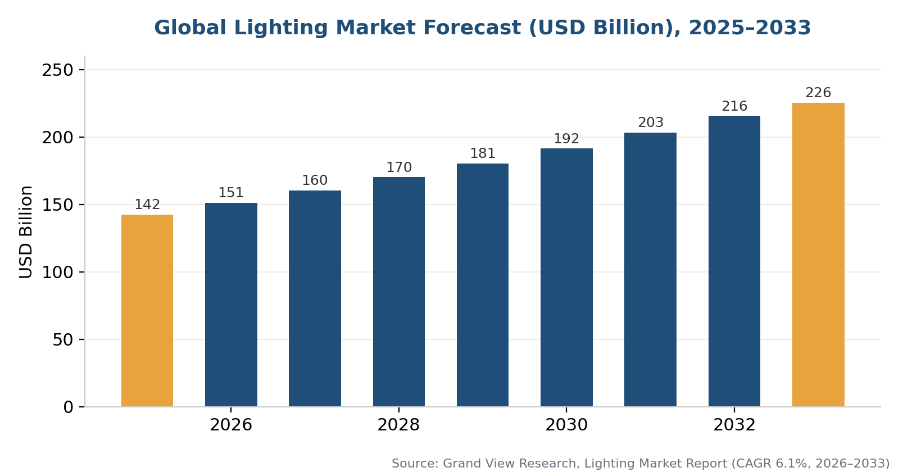
Lighting remains a large and steadily growing global industry, and the shift toward LED, smart, and energy-efficient products is reshaping what manufacturers must build and how quickly they must respond to demand.
| Indicator | Value | Source / Note |
|---|---|---|
| Global Lighting Market Size (2025) | ≈ USD 142.5 billion | Grand View Research |
| Projected Market Size (2033) | ≈ USD 225.6 billion | Grand View Research |
| Forecast Growth Rate (2026–2033) | ≈ 6.1% CAGR | Grand View Research |
| LED Share of Global Lighting | 60%+ of market | Technavio industry analysis |
| Asia Pacific Share of Demand | Largest regional share (~44–46%) | Technavio / Coherent Market Insights |
Growth is good news, but for custom and decorative lighting manufacturers, it also means more quotes, more revisions, more imported components, and more pressure on delivery dates. Operational systems either scale with that demand or become the bottleneck.
Why Lighting Manufacturers Outgrow Their Systems
Across decorative, architectural, and custom lighting businesses, the same operational pain points appear repeatedly. The table below maps each challenge to the Business Central capability that addresses it.
| Common Challenge | Business Impact | Business Central Answer |
|---|---|---|
| Every order is a little different (custom / engineer-to-order) | Quoting takes days; engineering knowledge lives in spreadsheets | Multilevel BOMs with versioning; copy-and-modify costing |
| True fixture cost is invisible until month end | Margin erosion discovered too late to act | Integrated costing; real-time actual vs. expected cost |
| Long lead imported components (drivers, crystals, specialty parts) | Stockouts, expedite fees, delayed production | MRP planning engine; vendor lead times; landed cost tracking |
| Large hospitality projects with phased deliveries | Milestone billing and WIP managed manually | Built-in project (jobs) module with budgets and progress billing |
| Outsourced plating, powder coating, glasswork | Subcontract costs and timing tracked outside the system | Native subcontracting within production routings |
| Disconnected departments and tools | No single version of the truth | One platform: finance, sales, purchasing, production, projects |
Business Central handles the three realities of this industry at once: the creativity of custom design (flexible BOMs and versioning), the discipline of precision production (routings, capacity, subcontracting), and the complexity of project-based delivery (jobs, milestone billing, WIP accounting).
Key Features for Lighting Manufacturers
1. Multi-Level Bills of Materials for Complex Fixtures
A single decorative fixture can contain dozens or hundreds of components: frames, arms, canopies, glass elements, shades, sockets, lamping, drivers, mounting hardware, and finish treatments. Business Central supports multilevel production BOMs with versioning, so engineering can model fixtures exactly as they are built, subassemblies, and all. For custom work, an existing BOM can be copied and modified in minutes, dramatically speeding up quoting for “similar but different” fixtures.
2. Accurate Estimating and Quoting
Because BOMs, routings, labor rates, subcontract costs, and vendor prices all live in the system, Business Central rolls up a realistic cost for any fixture, including custom ones. Sales teams produce professional, margin-aware quotes in hours instead of days, and revised configurations or alternate finishes can be replaced with confidence rather than guesswork.
3. Production Orders, Routings, and Shop Floor Visibility
Confirmed sales convert to production orders with defined routings: cutting, forming, welding, polishing, painting or plating, wiring, assembly, inspection, and packing. Work centers carry capacity and cost data, so scheduling reflects what the shop can genuinely deliver. Subcontracted operations of powder coating, plating, glass blowing, and specialty finishing are tracked natively as part of the production order, including their purchase orders and costs.
4. Material Requirements Planning (MRP) and Purchasing
The planning engine looks at open sales orders, production orders, forecasts, inventory, and vendor lead times, then proposes exactly what to buy or make, and when. For manufacturers dealing with imported components and long lead electrical parts, purchasing becomes proactive instead of reactive: expedited fees shrink, and production stops waiting on missing parts. Landed cost tracking captures freight, duty, and brokerage, so shelf cost reflects true cost.
5. Inventory, Warehousing, and Traceability
Business Central tracks inventory across multiple locations and bins raw materials, components, work InProgress, finished fixtures, and even crating supplies. Lot and serial tracking provide traceability for components such as LED drivers, supporting warranty services, and certification requirements. Bar-coded warehouse operations reduce picking errors and keep counts accurate.
6. Project Management for Hospitality and Commercial Jobs
Built-in project (jobs) functionality lets you manage a hotel, casino, restaurant, or corporate installation as a true project: phases and tasks, budgets, resources, items assigned to the job, milestone or progress billing, and work-in-progress accounting. Project managers see budget versus actual in real-time labor, materials, subcontracting, and freight instead of discovering overruns at the end.
7. Financial Management Built for Manufacturing
General ledger, receivables, payables, multicurrency, multi-entity consolidation, fixed assets, cash flow forecasting, and bank reconciliation with fully integrated costing. Actual production costs flow from the shop floor into the financials automatically, so margin reporting by item, order, customer, or project is real, current, and trustworthy.
8. Sales, Service, Reporting, and the Microsoft Ecosystem
Quotes, orders, partial shipments, returns, and warranty claims are managed in one place, with full visibility into production status for instant answers to “Where is my order?” Role based dashboards come standard, Power BI adds deep analytics (margin by product family, on time delivery, work center utilization, project profitability), and the Power Platform plus AppSource addons advanced scheduling, EDI, ecommerce, product configurators let the system evolve with your business.
| Module | Capabilities Most Relevant to Lighting |
|---|---|
| Manufacturing | Multilevel BOMs, versions, routings, work centres, subcontracting, capacity planning |
| Supply Chain | MRP, purchase planning, vendor pricing, landed cost, multi-location inventory, lot/serial tracking |
| Projects (Jobs) | Phases and tasks, budgets, WIP accounting, milestone/progress billing, resource planning |
| Finance | GL, AR/AP, multi-currency, consolidation, integrated production costing, cash flow |
| Sales and Service | Quotes, orders, partial/drop shipments, returns, warranty, Outlook integration |
| Analytics and Platform | Role dashboards, Power BI, Power Automate workflows, Teams, AppSource add-ons |
The Business Benefits: What Changes After GoLive
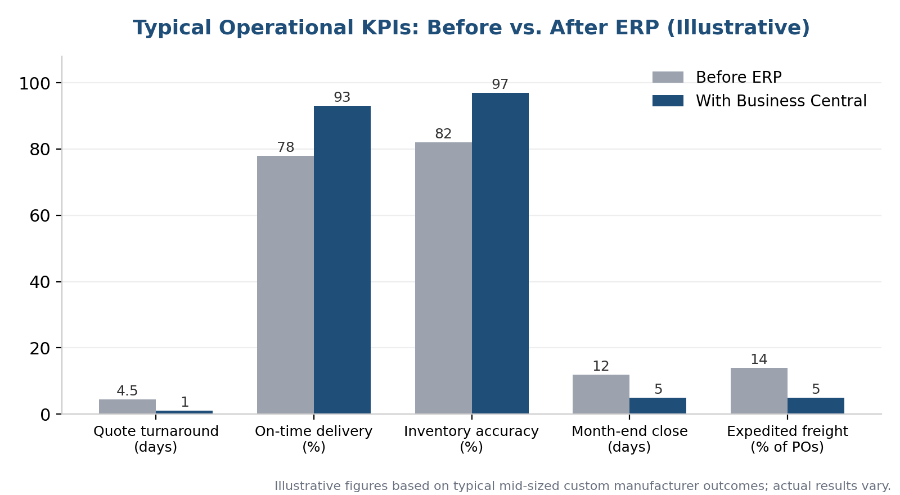
Features matter, but outcomes matter more. The chart and table below show the kind of operational improvement mid-sized custom manufacturers typically target and achieve after a well-run Business Central implementation. Figures are illustrative benchmarks; your baseline and results will differ.
| KPI | Typical Before | Typical After | Why It Improves |
|---|---|---|---|
| Quote Turnaround (Custom Fixtures) | 3–5 days | Same day – 1 day | Costed BOMs and routings reused instead of rebuilt |
| On-Time Delivery | 75–80% | 90%+ | Capacity-aware scheduling; MRP-driven purchasing |
| Inventory Accuracy | 80–85% | 95%+ | Bin/barcode warehousing; cycle counting |
| Month-End Close | 10–15 days | 3–5 days | Costs captured correctly all month long |
| Expedited Freight (Share of POs) | 10–15% | Under 5% | Proactive planning against vendor lead times |
| Project Margin Visibility | After completion | Real-time | Job budgets vs. actuals updated continuously |
What to Expect from an Implementation
A realistic picture of the journey is just as important as the feature list. Most midsized manufacturers go live in phases over roughly three to six months, often starting with financials, sales, purchasing, and inventory, then layering in full production and project management.
| Phase | Typical Duration | Key Activities |
|---|---|---|
| 1. Discovery and Process Mapping | 2–4 weeks | Workshops across quoting, engineering, purchasing, production, projects, finance; future-state design |
| 2. Solution Design and Configuration | 4–8 weeks | Chart of accounts, item and BOM structures, costing methods, locations/bins, workflows, document layouts |
| 3. Data Migration | 3–6 weeks (parallel) | Cleansing and loading customers, vendors, items, BOMs, open orders, opening balances |
| 4. Training and User Adoption | 2–4 weeks | Role-based training for office and shop floor using your own products and real scenarios |
| 5. Pilot, Go-Live and Stabilization | 4–6 weeks | Conference-room pilot, cutover, intensive hypercare support while habits form |
| 6. Continuous Improvement | Ongoing | Quarterly reviews, Power BI reports, workflow automation, add-on apps, Microsoft updates |
An ERP project requires real involvement from your own team. The manufacturers who get the best results assign a project owner, involve key users early, clean their data seriously, and treat implementation as a business transformation, not an IT purchase.
Is Business Central Right for Your Lighting Business?
Business Central is a particularly strong fit if your company:
- Builds custom, made-to-order, or engineer-to-order fixtures alongside standard product lines
- Manages multi-tooth hospitality or commercial projects with phased deliveries and milestone billing
- Relies on subcontracted finishing such as plating, powder coating, or specialty glasswork
- Sources components internationally and struggles with lead times and landed costs.
- Has outgrown QuickBooks, Tally, or spreadsheet-driven operations
- Already lives in the Microsoft ecosystem (Outlook, Excel, Teams) and wants tools that work together.
Lighting manufacturing sits at a demanding intersection: the creativity of custom design, the discipline of precision production, and the complexity of project-based delivery. Dynamics 365 Business Central is one of the few ERP platforms in its class that genuinely covers all three connecting quotes, BOMs, the shop floor, suppliers, projects, and financials into a single, modern, cloud-based system.
Ready to see whether it fits your business?
Our team specializes in implementing Dynamics 365 Business Central for manufacturers. We would be glad to walk you through a demonstration tailored to your products, processes, and projects. Visit www.madhda.com to start the conversation.
Frequently Asked Questions
| Question | Answer |
|---|---|
| Can it handle both catalog products and one-off custom fixtures? | Yes. Standard items run on stable BOMs and routings; custom fixtures use copied and modified BOMs, versioning, and the projects module — all in one system. |
| How long does implementation take? | Most mid-sized projects run 3–6 months depending on scope, data quality, and whether production and projects go live together or in phases. |
| Does it support multiple locations or companies? | Yes — multiple warehouses and locations, multiple companies with consolidation, and multi-currency for international sales and sourcing. |
| Can data from QuickBooks/Tally and Excel be migrated? | Yes. Customers, vendors, items, open transactions, and balances are routinely migrated; data cleansing beforehand is the key step. |
| Is the cloud secure and reliable? | Business Central runs on the Microsoft cloud with enterprise-grade security, automatic backups, and regular updates — accessible from office, shop floor, or job site. |