




Finance operations may vary across industries, but the core processes – bookkeeping, financial reporting, accounts receivable, and accounts payable – remain consistent. As businesses grow, traditional manual accounting can become a bottleneck. This is where accounting automation plays a transformative role.
Modern companies increasingly rely on AI-powered accounting software, robotic process automation (RPA) and cloud solutions to streamline financial workflows. Organizations that fail to adopt automation will inevitably experience operational delays, higher costs, and lower productivity. Those who embrace it benefit from faster, more accurate, and more scalable financial operations.
At Madhda BPO Services, we help businesses modernize their accounting processes so they can operate more efficiently and stay competitive.
What Is Accounting Automation?
Accounting automation uses intelligent software to carry out essential financial tasks with minimal human intervention. These tasks include:
- Account reconciliation
- Invoice processing
- Financial statement preparation
- Bank data syncing
- Transaction recording
Thanks to AI, machine learning, big data analytics, and cloud technology, automated accounting systems can handle complex financial tasks that require hours of manual effort.
Automation eliminates repetitive work like data entry, verification, and calculations – enabling CPAs and finance teams to focus on forecasting, strategy, and value-driven activities rather than administrative tasks.
Benefits of Accounting Automation
1. Faster Processing & Turnaround
Automation accelerates processes like reconciliation, reporting, and monthly-end close. This allows teams to deliver outputs faster, helping businesses improve financial agility and expand their service capacity.
2. Higher Data Accuracy
Even the most experienced accountants can make occasional entry mistakes. Automated accounting tools significantly reduce human error, ensuring reliable and precise financial data.
3. Lower Operating Costs
Automation reduces manual workload and minimizes the need for large teams dedicated to repetitive tasks. Businesses save on resource costs and accelerate return on investment.
4. Better Financial Insights
With real-time dashboards and analytics, finance teams can:
- Detect anomalies
- Predict trends
- Identify risks
- Make data-backed decisions
No coding or IT support is needed.
5. Enhanced Security & Data Protection
Cloud-based automated systems ensure secure storage, controlled access, and regular backups – an upgrade from error-prone paper-based processes.
6. Easy & Quick Data Retrieval
Automation enables fast search and retrieval using metadata, document names, or tags. No more time wasted sorting through files or physical ledgers.
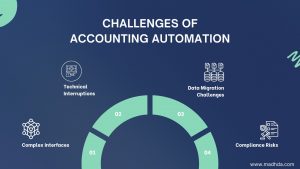
Challenges of Accounting Automation
1. Complex Interfaces
Some advanced tools come with learning curves. However, most modern software provides tiered versions, making them suitable for startups, SMEs, and enterprises.
2. Technical Interruptions
IT issues, downtime, or internet disruptions can occur occasionally. Reliable IT support and cloud-based solutions significantly reduce such risks.
3. Data Migration Challenges
Migrating from legacy systems can result in missing fields or mismatched data. Proper integration planning helps avoid these issues.
4. Compliance Risks
Incorrect data fed into automated systems can lead to compliance errors. Regular monitoring ensures that all outputs are accurate and audited.
Top 6 Accounting Processes Business Should Automate Today
1. Payroll Processing Automation
Payroll requires precise calculations, tax deductions, and employee validations. Automated payroll systems ensure:
- Accurate salary calculations
- Timely disbursements
- Tax compliance
- Integration with attendance/time-tracking
This improves employee satisfaction and saves hours of manual effort.
2. Purchase Order & Procurement Automation
Automation simplifies purchase order creation, invoice matching, and vendor payment tracking. This ensures:
- Fewer documentation errors
- Faster procure-to-pay cycles
- Streamlined vendor communication
- Cost savings
3. Financial Administration Automation
During busy periods like month-end close or tax season, automation helps manage:
- Error detection
- Data validation
- Missing invoices
- Compliance checks
Teams can close books faster and more accurately.
4. Expense Management Automation
Collecting receipts manually often delays reporting. Automated systems allow employees to:
- Upload receipts digitally
- Sync corporate card expenses
- Auto-categorize transactions
- Push entries directly into accounting software
This ensures accuracy and speeds up reimbursement cycles.
5. Accounts Payable (AP) & Accounts Receivable (AR) Automation
AP/AR automation improves cash flow visibility and eliminates delays by:
- Automatically tracking outstanding invoices
- Sending payment reminders
- Flagging high-risk accounts
- Ensuring timely vendor payments
Businesses gain real-time financial visibility and better working capital management.
6. Cash Flow Forecasting & Financial Visibility
Automated tools help finance teams instantly generate:
- Cash flow forecasts
- Trend analysis reports
- Expense and sales predictions
- Aging summaries
Accurate cash visibility helps leadership make better strategic decisions.
Will Automation Replace Accountants or CPAs?
The short answer: No. It will enhance their capabilities – not replace them.
While automation eliminates repetitive tasks, it cannot replace human judgment, advisory expertise, or strategic decision-making.
AI and automation tools are simply enabling CPAs to:
- Work smarter
- Deliver deeper insights
- Improve accuracy
- Offer business-oriented financial guidance
The future of accounting is a partnership between technology and expert professionals.
Final Takeaway
Accounting automation is no longer optional – it is essential for businesses that want to stay competitive, agile, and efficient. By adopting advanced accounting tools, companies can reduce operational costs, enhance accuracy, and unlock powerful insights.
At Madhda BPO Services, we help businesses implement scalable and cost-effective automation solutions tailored to their needs – from payroll and AP/AR to financial reporting and cash flow forecasting.
Automation empowers your accounting team to focus on high-value, strategic work – letting your business grow faster and smarter.