 LinkedIn
  You-tube



Have you ever looked at your bank account at the end of the month and wondered where did all the money went? You closed deals, sent invoices, delivered services, yet the numbers don’t add up. Sound familiar?
You’re not alone. Thousands of business owners generate solid revenue but still struggle to keep cash flowing smoothly. And more often than not, the root cause isn’t a sales problem; it’s a bookkeeping problem.
Poor financial recordkeeping leads to missed invoices, surprise tax bills, uncontrolled expenses, and zero visibility into where your business stands. But here’s the good news: when you fix your bookkeeping, you fix your cash flow.
In this blog, we’ll walk you through exactly how better bookkeeping practices can transform your cash flow from tracking outstanding payments to building accurate forecasts. By the end, you’ll have a practical roadmap to take control of your finances, reduce stress, and set your business up for sustainable growth.
What Is Cash Flow and Why Does It Matter More Than Profit?
Before diving into solutions, let’s get clear on the basics.
Cash flow is the movement of money into and out of your business over a given period. It’s not the same as profit. A business can show a healthy profit on paper and still run out of cash if clients are slow to pay; expenses spike unexpectedly, or payroll hits before a big payment clears.
Here’s a simple way to think about it:
- Cash Inflow – Money flowing into your business through customer payments, sales revenue, loans, and investment income
- Cash Outflow – Money leaving your business to cover rent, staff salaries, supplier bills, tax payments, and loan repayments
- Net Cash Flow – What’s left when you subtract your outflows from your inflows. A positive number means you’re in good shape. A negative number is a warning sign worth paying attention to.
Positive net cash flow keeps your business alive and growing. Negative cash flow even temporarily can bring operations to a halt. This is exactly where bookkeeping becomes your most powerful financial tool.
8 Ways Better Bookkeeping Improves Your Cash Flow
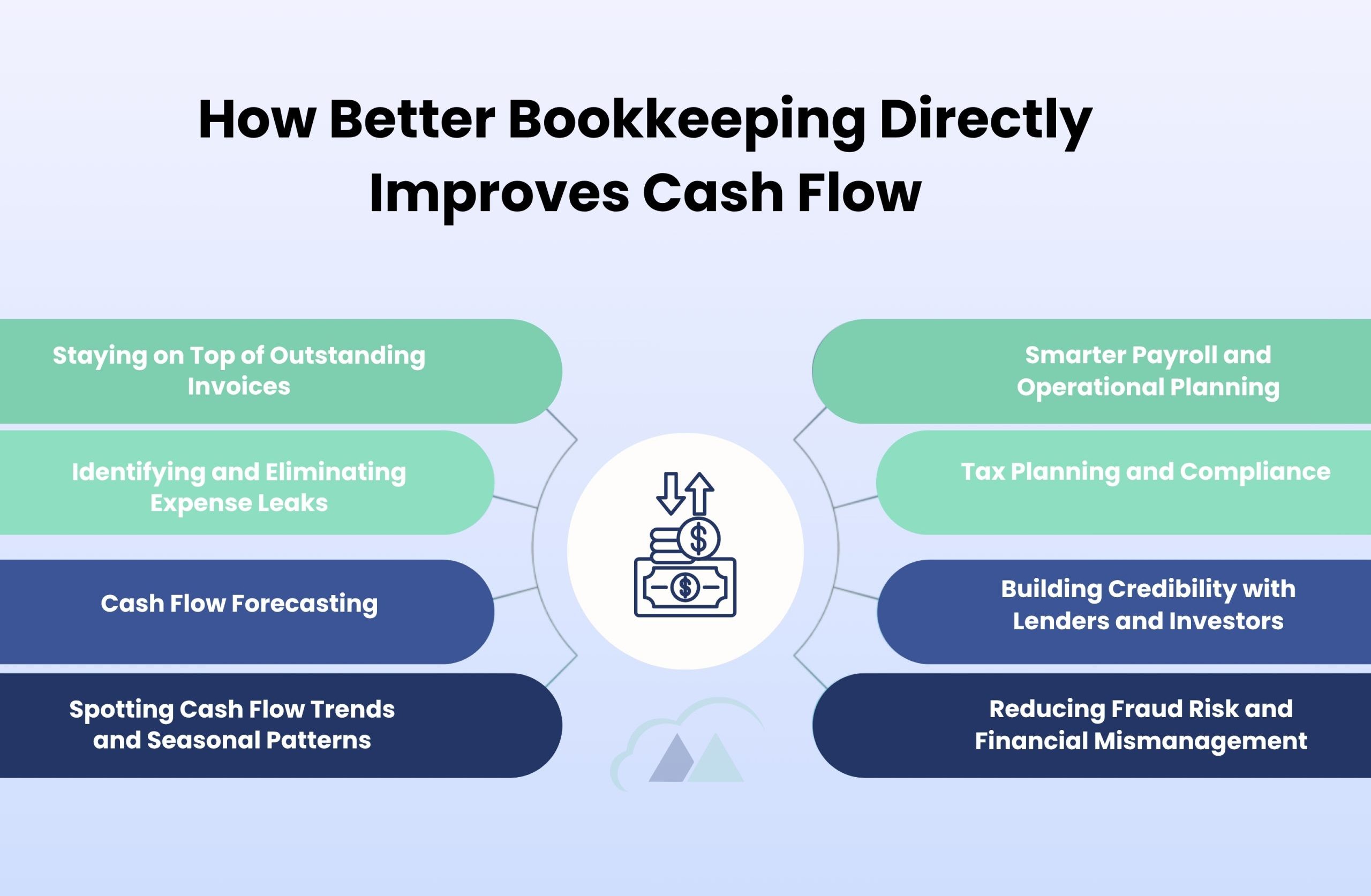
1. Staying on Top of Outstanding Invoices
Late payments are one of the biggest cash flow killers for small and midsized businesses. When invoices go out and then disappear into the void, weeks pass before anyone follows up and by then, the damage is done.
Good bookkeeping means:
- Every invoice is logged immediately after a sale or service delivery
- Due dates are tracked in real time
- Automated or scheduled payment reminders are sent before and after due dates
- Overdue accounts are flagged and actioned quickly
Pro Tip: Invoice the moment a job is complete not at the end of the month. The sooner an invoice goes out, the sooner the cash comes in.
2. Identifying and Eliminating Expense Leaks
It’s easy to overlook small, recurring costs for a software subscription you no longer use, a vendor charging more than their competitors, or duplicated service fees. These “spending leaks” add up fast.
Regular bookkeeping gives you a clear, categorized view of every rupee or dollar leaving your business. When you review expense reports consistently, you can:
- Spot unnecessary or redundant subscriptions
- Renegotiate supplier contracts from a position of information
- Identify departments or projects consistently overspending
- Cut nonessential costs without impacting operations
Think of it as auditing your outflow something that’s impossible to do without clean, UpToDate books.
3. Cash Flow Forecasting: Know What’s Coming Before It Arrives
One of the most powerful things accurate bookkeeping enabled is cash flow forecasting the ability to project your financial position weeks or months into the future.
With reliable historical records, you can:
- Estimate upcoming revenue based on open invoices and expected sales
- Map out scheduled expenses rent, payroll, tax deadlines, loan repayments
- Spot potential shortfalls before they become crises
- Plan purchases, hires, or expansions with confidence
Businesses that forecast their cash flow don’t get blindsided. They prepare. And preparation is the difference between a financial hiccup and a financial disaster.
4. Spotting Cash Flow Trends and Seasonal Patterns
Your business almost certainly has patterns of months where revenue spikes, quarters where costs balloon, periods where collections slow down. Without organized financial records, these trends are invisible.
With consistent bookkeeping, you can look back across weeks, months, and years to answer questions like:
- Which months historically bring in the most cash?
- When do payables tend to pile up?
- Are there seasonal dips that require advance planning?
- Is the gap between invoicing and payment growing over time?
Understanding your cash flow rhythm allows you to build smarter budgets, negotiate better payment terms, and avoid being caught off guard by predictable fluctuations.
5. Smarter Payroll and Operational Planning
Payroll is typically one of the business’s largest cash outflows. Without visibility into your financial position, meeting payroll can create serious anxiety, especially during slower revenue periods.
Effective bookkeeping keeps you ahead of this by:
- Tracking payroll obligations in real time alongside cash balances
- Projecting future payroll costs as you plan hiring
- Aligning payment schedules with when revenue is expected to clear
- Ensuring tax and superannuation/provident fund contributions don’t sneak up on you
When your books are in order, payroll becomes a managed, predictable expense, not a monthly scramble.
6. Tax Planning and Compliance No More Nasty Surprises
Tax time is stressful for businesses that haven’t kept up with their records. When bookkeeping is inconsistent, tax preparation becomes an expensive, time-consuming emergency and there’s often money left on the table through missed deductions.
Well maintained books mean:
- Tax liabilities are estimated throughout the year, not just at filing time
- GST, TDS, and other compliance obligations are tracked and met on time
- All eligible deductions and credits are captured and documented
- There’s no scramble to gather receipts, invoices, or records at yearend
This translates directly to better cash flow because you’re setting aside the right amount for taxes, not being hit with an unexpected bill that drains your account.
7. Building Credibility with Lenders and Investors
If you ever need a business loan, a credit line, or investment funding, lenders and investors will want to see one thing above all else: clean, accurate financial records.
Strong bookkeeping builds your financial credibility by:
- Demonstrating consistent, trackable revenue and expense management
- Providing auditable cash flow statements and balance sheets
- Showing lenders you understand your own financial position
- Making it easier to negotiate favorable loan terms and lower interest rates
Access to external capital is a powerful tool for managing cash flow gaps. But you can only unlock it if your books tell a clear, trustworthy story.
8. Reducing Fraud Risk and Financial Mismanagement
Without a proper bookkeeping system, financial irregularities can go undetected for months. Unauthorized transactions, duplicate payments, and billing errors quietly drain cash without anyone noticing.
A structured bookkeeping process creates a checks and balances system that:
- Requires all transactions to be documented and categorized
- Enables regular reconciliation of bank statements against records
- Makes anomalies easy to spot during routine reviews
- Reduces dependence on single individuals for financial oversight
Protecting your business from financial leakage internally or externally is as important as growing revenue.
Practical Bookkeeping Habits That Improve Cash Flow
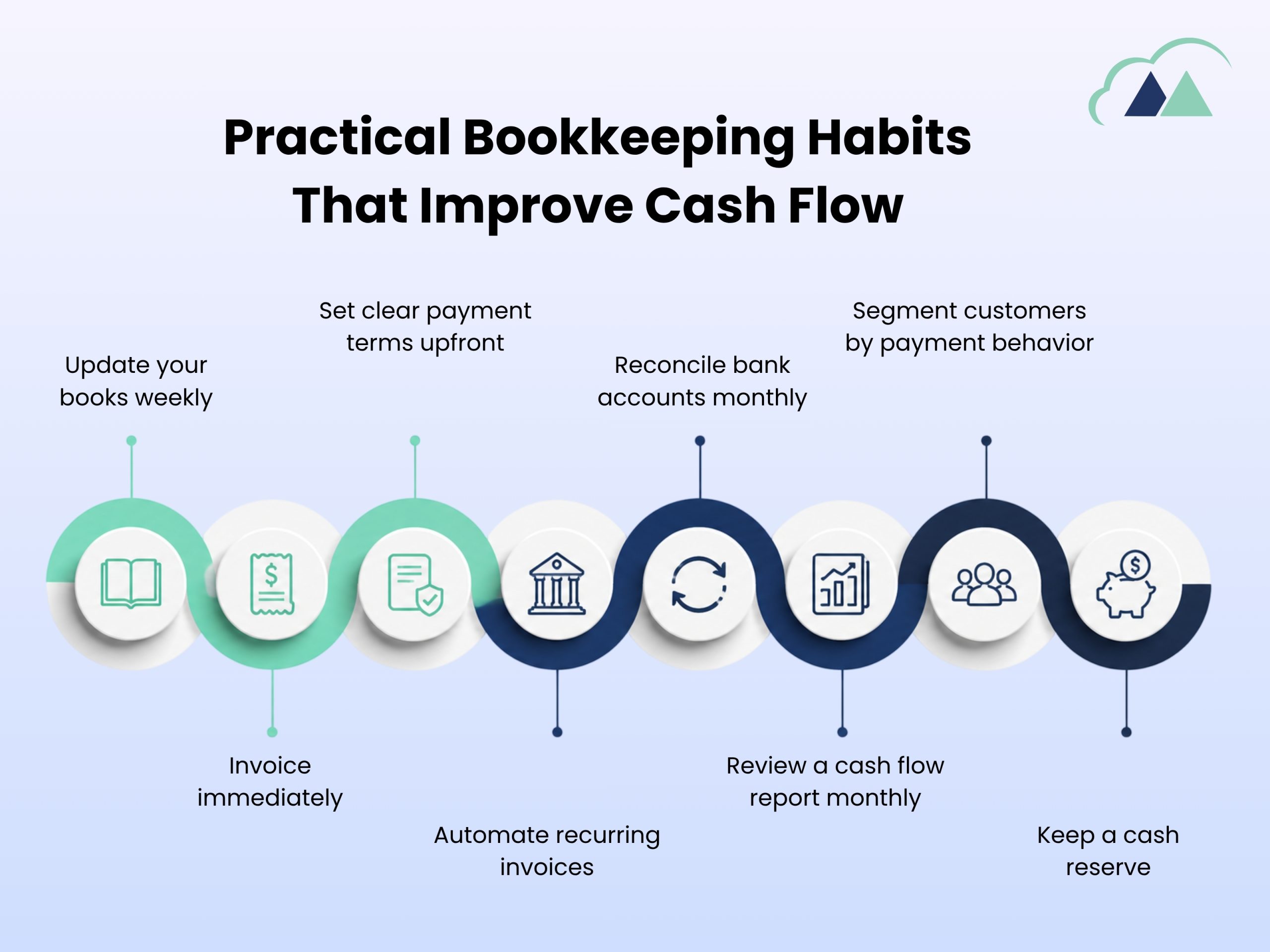
You don’t need to overhaul your entire finance department overnight. Start with these high impact habits:
- Update your books weekly – Don’t let records pile up. Frequent updates mean fewer errors and more accurate real time data.
- Invoice immediately – The moment a service is delivered or a product ships, send the invoice.
- Set clear payment terms upfront – Specify payment due dates, late fees, and accepted payment methods in every contract or invoice.
- Automate recurring invoices – For retainer clients or subscription customers, use bookkeeping software to generate and send invoices automatically.
- Reconcile bank accounts monthly – Compare your bookkeeping records against actual bank statements to catch discrepancies early.
- Review a cash flow report monthly – Make it a habit to review your inflows, outflows, and projections every month, not just at tax time.
- Segment customers by payment behavior – Know who pays on time, who needs reminders, and who consistently delays. Adjust your terms and follow-up accordingly.
- Keep a cash reserve – Aim to maintain a buffer of at least one to three months of operating expenses, informed by your bookkeeping data.
Bookkeeping Software vs. Professional Bookkeeping Services: What’s Right for You?
Many business owners start with software tools like Tally, Zoho Books, QuickBooks, or Xero. These platforms are excellent for automation, invoice generation, and basic reporting. However, software is only as good as the data entered and the person interpreting the reports.
As your business grows, the complexity of your finances grows with it making professional bookkeeping services increasingly valuable.
Consider professional bookkeeping support when:
- You’re spending more than a few hours per week on financial admin
- You’re unsure whether your records are accurate or compliant
- Cash flow surprises keep catching you off guard
- You’re planning to seek funding or scale operations
- Tax season feels like a fire drill every year
A professional bookkeeper doesn’t just enter numbers as they interpret patterns, flag risks, and help you make smarter financial decisions.
How Madhda Can Help You Take Control of Your Cash Flow
At Madhda BPO, we understand that running a business means wearing too many hats. Bookkeeping often ends up on the back burner until a cash flow crisis forces it to the front.
Our team of experienced bookkeeping professionals helps businesses like yours:
- Set up clean, organized financial systems from the ground up
- Maintain accurate, UpToDate records every week or month
- Generate clear cash flow reports and forward-looking forecasts
- Stay compliant with tax obligations without lastminute stress
- Identify expense leaks and invoicing gaps before they impact operations
Whether you’re a startup finding your footing or an established business ready to scale, Madhda BPO Services brings the financial clarity you need to make confident decisions and keep cash flowing.
Cash flow isn’t just a financial metric it’s the pulse of your business. And better bookkeeping is the single most effective tool for keeping that pulse strong, steady, and predictable.
When your records are clean, your invoices go out on time, your expenses are tracked, and your tax position is known everything else gets easier. You make better decisions. You plan with confidence. And you stop losing sleep over whether next month’s payroll will clear.

Ready to strengthen your cash flow? Let’s talk.
Discover how better bookkeeping can change the financial trajectory of your business.
Start small if you need to pick one bookkeeping habit from this list and build it from there or Reach out to Madhda Inc and let us do the heavy lifting so you can focus on what you do best to grow your business.